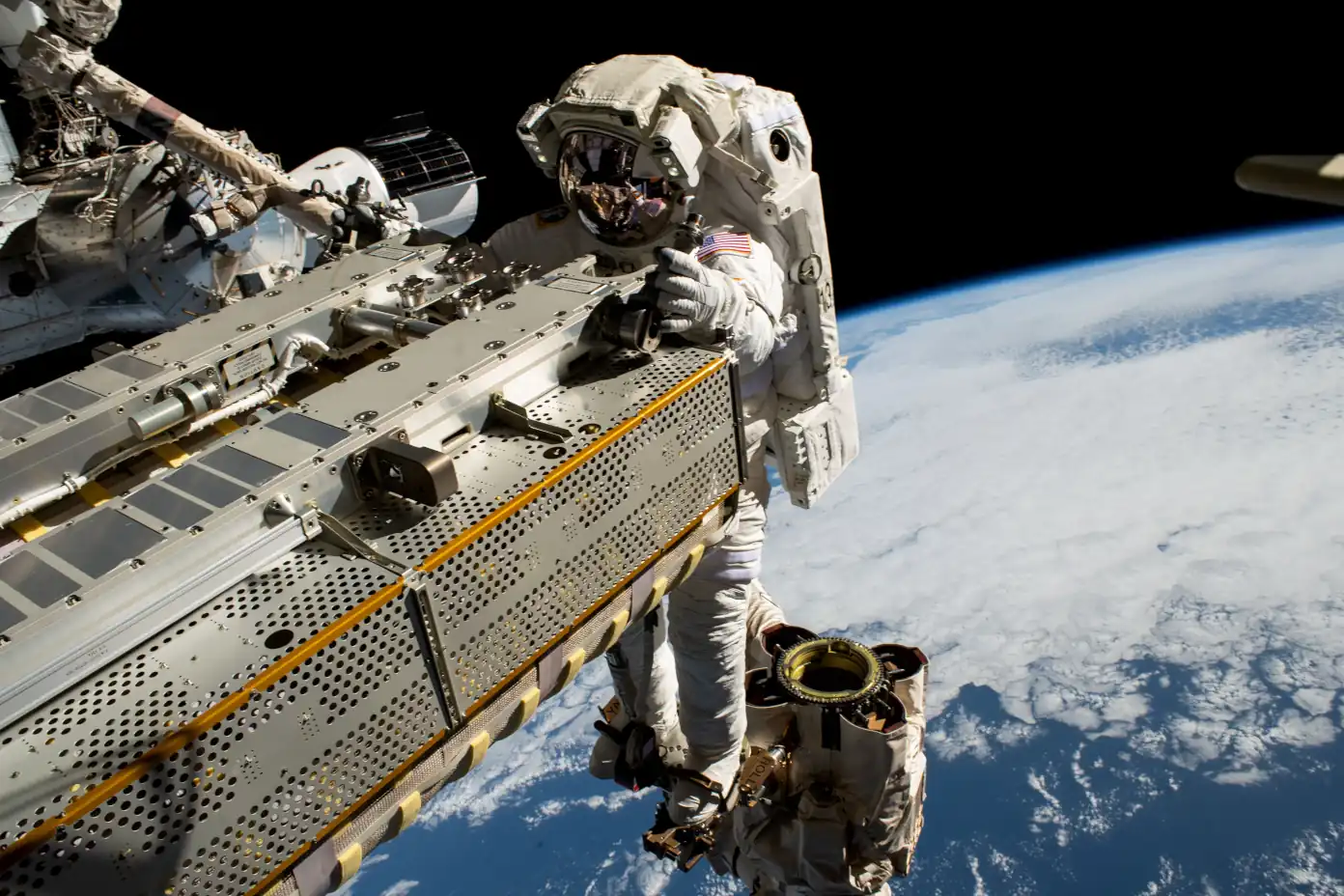
In a significant step forward for international space research, a pair of American astronauts are scheduled to embark on a 6.5-hour spacewalk to conduct vital upgrades on the International Space Station’s (ISS) solar panel array. This mission is essential for augmenting the power capabilities of the orbiting laboratory, ensuring it remains a viable hub for scientific discovery for years to come.
The Crew: Experience Meets New Frontiers
The upcoming mission pairs a seasoned veteran with a rising star in the space program: Jessica Meir and Chris Williams. This excursion will mark Meir’s fourth spacewalk, further cementing her reputation as an expert in extravehicular activities. Meir is well-known for her historic participation in the first all-female spacewalk during her previous 205-day tenure aboard the ISS in 2019-2020.
Joining her is Chris Williams, a physicist specializing in deep-space telescopes. Williams, who is currently midway through an eight-month tour that began in late 2025, is venturing into the vacuum of space for the first time. His background in unraveling the origins of the universe provides a unique perspective to the crew’s technical capabilities.
Mission Profile Summary
| Mission Parameter | Details |
|---|---|
| Primary Objective | Solar Array Power Upgrades |
| Scheduled Duration | 6.5 Hours |
| Airlock Exit Point | Quest Airlock |
| Lead Astronaut | Jessica Meir (4th Spacewalk) |
| Support Astronaut | Chris Williams (Inaugural Spacewalk) |
Operational Resilience Amid Challenges
The resumption of these critical missions follows a period of significant logistical shifts for the ISS crew. Earlier this year, NASA managed its first medical evacuation in 65 years of human spaceflight. This incident involved one of four astronauts launched via SpaceX, whose health concerns necessitated an immediate return to Earth.
During the interim, Chris Williams remained on the station with a skeleton crew, including two Russian cosmonauts, to maintain essential operations. The reduced staffing levels led to a temporary suspension of planned spacewalks and a revision of ongoing research initiatives. However, with Meir and three additional crew members recently arriving via a SpaceX capsule, the station has returned to its full operational capacity.
Technical Objectives Outside the Quest Airlock
As Williams and Meir exit the Quest airlock, they will carry a specialized modification kit designed for the station’s exterior. Their primary focus involves routing cables that are fundamental to the upcoming solar array enhancements. These upgrades are vital for maintaining the station’s complex electrical systems and supporting the next generation of orbital experiments.
For readers in Western New York, these missions represent the peak of human ingenuity—a theme we frequently explore here at the Lake Erie Times as we track how global scientific advancements impact our regional understanding of technology and education.
About the Author: William Strasmore is a dedicated news reporter for the Lake Erie Times, delivering in-depth coverage and incisive analyses on regional and national issues. With a background in investigative journalism, William is committed to uncovering the truth with accuracy and integrity. For more from William, visit his author page.
Disclaimer: The content provided by Lake Erie Times is for informational purposes only and should not be considered as professional legal or financial advice.
Affiliate Disclaimer: Some links on Lake Erie Times are affiliate links. This means that if you make a purchase through these links, we may earn a commission at no additional cost to you. Our recommendations are based on careful research and our commitment to quality journalism.
Stay connected with more local and national updates at the Lake Erie Times.