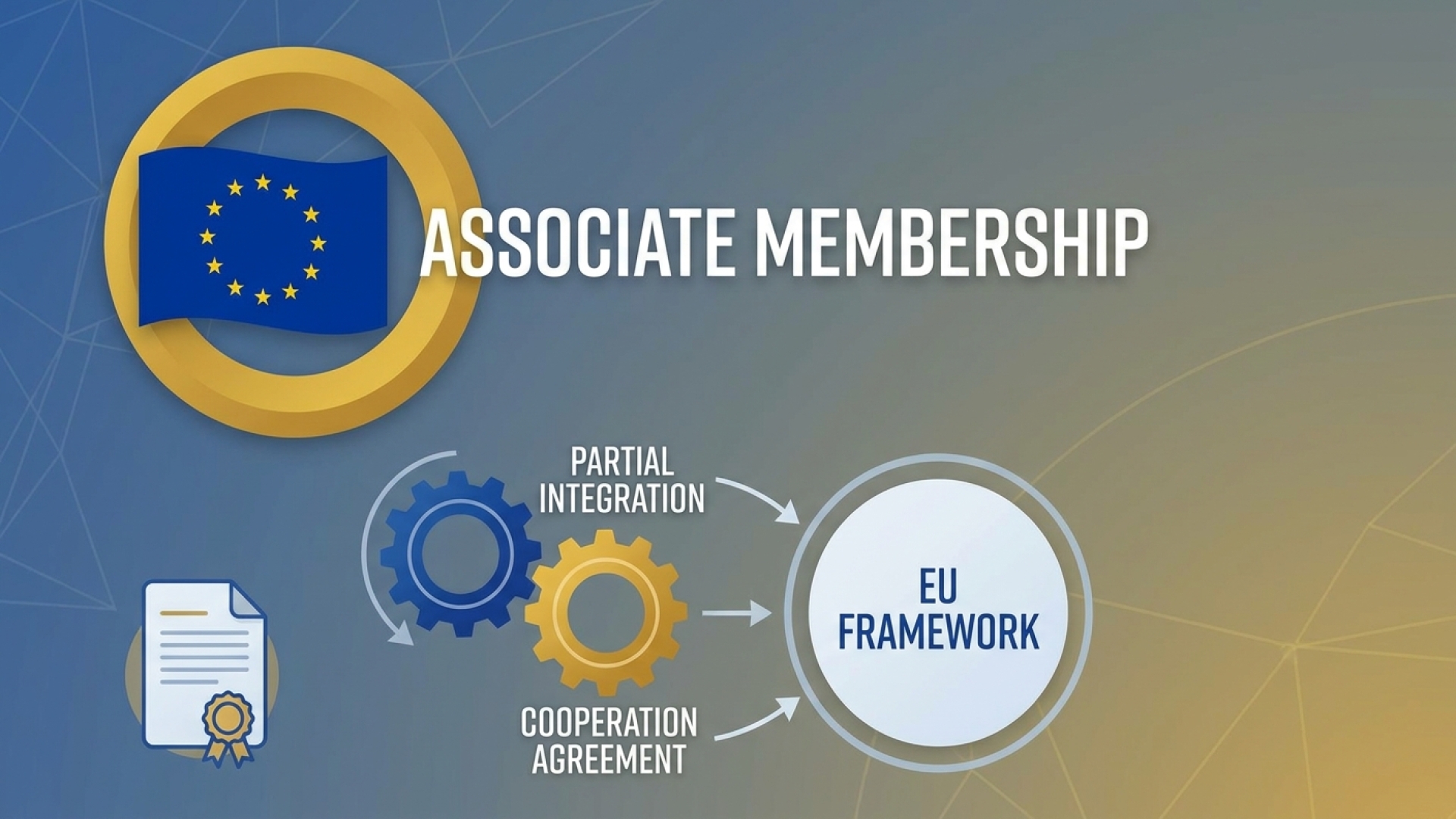
Associate membership to the EU is a practical, but partial, form of integration. It allows non-member countries to align with parts of EU law, access selected markets and programs, and maintain closer institutional ties without joining the European Union. The term does not describe one uniform legal status; instead, it covers a range of association frameworks tailored to different countries and political circumstances.
For readers of Lake Erie Times who track global trade, business, and foreign policy, the concept matters because these arrangements can shape export opportunities, regulatory standards, investment confidence, and Europe’s broader strategic influence.
What Associate Membership Means
In practice, associate membership refers to a country’s close cooperation with the EU through formal agreements, sectoral partnerships, or participation in EU policy frameworks. Unlike full membership, it does not grant voting rights in EU institutions, representation in the European Parliament, or unconditional participation in the single market.
These arrangements are commonly built through association agreements, stabilization and association agreements, participation in the European Economic Area, or the European Neighbourhood Policy. Each framework creates a different level of integration, depending on the country’s relationship with Brussels and the EU’s strategic interests.
Associate Status Versus Full EU Membership
| Area | Full EU member state | Associate or associated partner |
|---|---|---|
| Decision-making | Votes in the Council of the European Union, the European Council, and the European Parliament. | Participates in dialogues, committees, or sectoral bodies but does not hold a vote in EU institutions. |
| Single market access | Participates in the EU single market, including the free movement of goods, services, capital, and people. | May gain access to parts of the single market, often goods, but usually not the full set of market freedoms. |
| Regulatory alignment | Applies EU law as a member of the union. | Often adopts or aligns with selected areas of EU law, particularly in trade, standards, and regulatory policy. |
| Political representation | Appoints ambassadors, participates in rotating Council presidencies, and elects Members of the European Parliament. | Engages through diplomatic channels, intergovernmental bodies, and structured policy dialogue. |
| Budget role | Contributes to and benefits from the EU budget. | May contribute to or participate in specific programs, but does not take part in the overall EU budget in the same way. |
Common Association Arrangements
Western Balkans: stabilization and association agreements
Countries in the Western Balkans, including Serbia, Montenegro, Albania, North Macedonia, Bosnia and Herzegovina, and Kosovo, have signed stabilization and association agreements with the EU. These agreements cover trade liberalization, political cooperation, judicial reform, and alignment with EU standards. While they are not full membership, they often serve as a structured pathway toward deeper integration.
Ukraine, Moldova, and Georgia
Ukraine, Moldova, and Georgia signed Association Agreements with the EU that include political cooperation frameworks and Deep and Comprehensive Free Trade Areas. These agreements are designed to support democratic reforms, strengthen institutions, and expand trade ties. Ukraine and Moldova were granted candidate status in 2022, while Georgia has also pursued candidate status as part of the EU’s broader enlargement agenda.
Turkey: customs union and candidate status
Turkey has maintained a long association with the EU through the EU-Turkey Customs Union, which dates back to 1995. The arrangement allows tariff-free trade in many industrial goods and some agricultural products, but it does not fully cover services, agriculture, or public procurement. Turkey’s status shows both the depth and the limits of associate-style partnerships.
European Economic Area and Switzerland
The European Economic Area extends the EU single market to three of the four European Free Trade Association states: Iceland, Liechtenstein, and Norway. These countries participate in the free movement of goods, services, capital, and people without being EU members. Switzerland, the fourth EFTA state, is not in the EEA but maintains a separate set of bilateral agreements with the EU covering trade, movement of persons, and other policy areas.
Benefits and Limitations of Associate Status
Associate arrangements can offer meaningful advantages, but they also come with important constraints. The value of the status depends heavily on the specific agreement and the country’s ability to implement the required reforms.
Key benefits
- Market access: Preferential or duty-free access to the EU market can be especially valuable for trade-dependent economies.
- Regulatory credibility: Alignment with EU standards can improve a country’s trade reputation and attract foreign investment.
- Political signal: Association agreements often reflect a commitment to democratic governance, rule of law, and human rights.
- Pathway to deeper ties: For many countries, association serves as a stepping stone toward eventual EU membership.
Key limitations
- No formal vote: Associate partners cannot shape EU policy through formal voting rights in EU institutions.
- Asymmetric obligations: Countries may be required to adopt EU rules without full input into how those rules are developed.
- Conditional arrangements: Agreements can be amended, suspended, or terminated, which can create uncertainty.
- Partial market access: Sectors such as agriculture, services, and public procurement are often only partially covered.
The Path From Association to Full Membership
For countries that seek full EU membership, associate status is usually one stage in a longer process. The path can be slow, politically sensitive, and highly conditional on reform progress.
- Candidate status: The country formally applies to join the EU and commits to the Copenhagen criteria, including stable democratic institutions, the rule of law, human rights protection, and a functioning market economy.
- Accession negotiations: The country works through 35 policy chapters covering areas such as competition, internal market rules, agriculture, environment, justice, and foreign policy.
- Ratification and accession: All 27 EU member states and the European Parliament must approve accession, and the candidate must continue meeting implementation requirements throughout the process.
Croatia’s accession in 2013, after 13 years of negotiations, shows that membership is possible but demanding. Serbia and Albania have continued to progress toward EU accession, underscoring that the process requires sustained reform, political commitment, and institutional trust.
Why Associate Membership Matters Now
In a period of geopolitical uncertainty, the EU’s associate frameworks serve as a key tool of foreign and economic policy. They help stabilize neighboring regions, secure supply chains, and extend European democratic norms without requiring full membership.
For businesses and policymakers in Western New York, the implications can be indirect but real. Changes in EU trade rules, regulatory standards, and geopolitical alignments can affect supply chains, investment decisions, and export planning for companies with European connections.
Associate membership to the EU is not a single destination. It is a flexible and evolving form of cooperation that reflects the specific political, economic, and strategic interests of the countries involved. Whether used as a bridge to full membership or as a durable structure of partnership, it remains one of the most important tools of European integration in the 21st century.