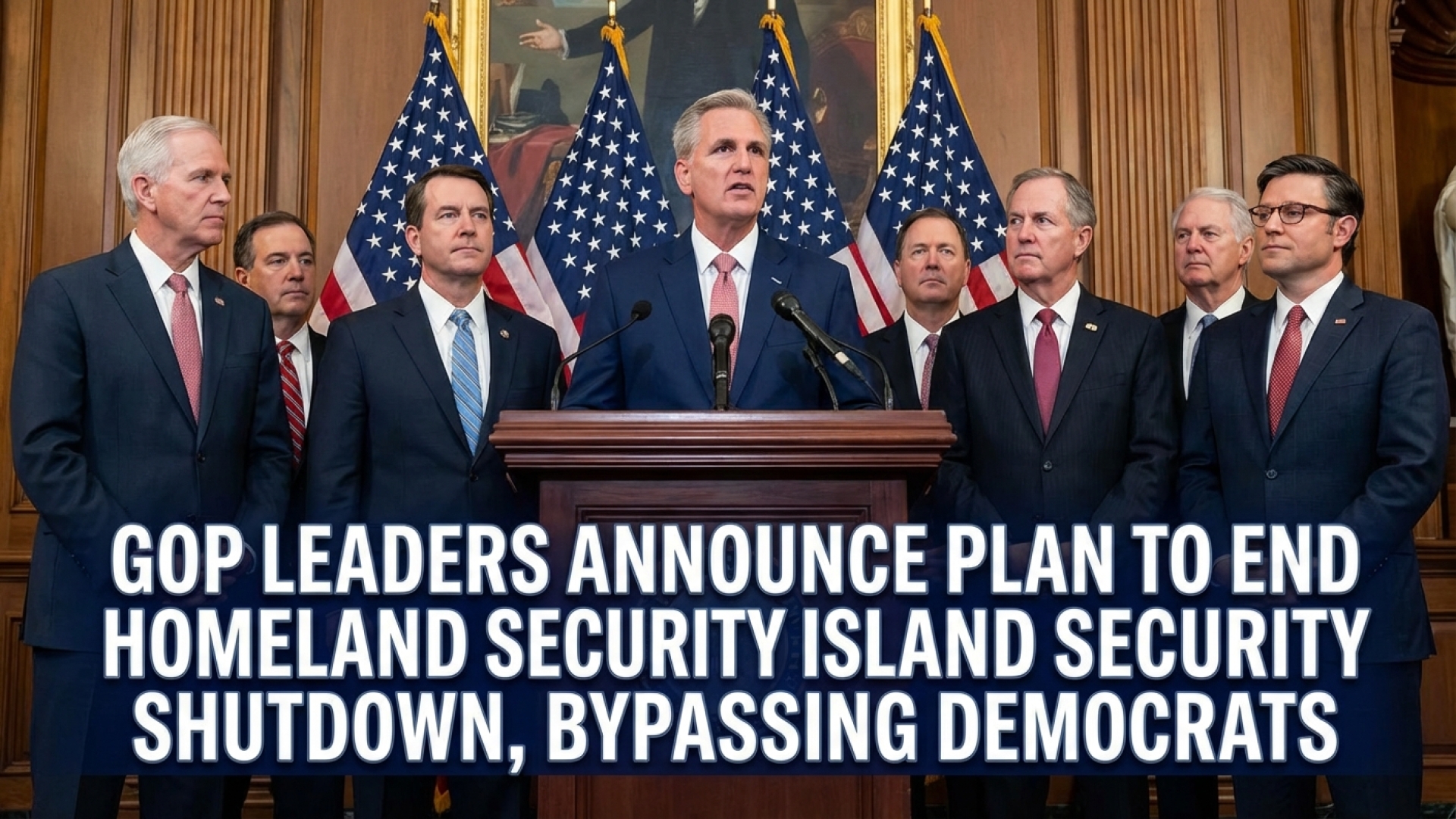
As the partial government shutdown continues to impact Department of Homeland Security (DHS) operations—a move felt deeply in border-adjacent regions like Western New York—Republican leadership in Washington has signaled a new path forward. House Speaker Mike Johnson and Senate Majority Leader John Thune have unveiled a strategic plan aimed at fully funding the department, aligning with directives from President Donald Trump to resolve the current fiscal impasse.
The Proposed Path Forward for DHS Funding
In a joint statement, House Speaker Mike Johnson (R-La.) and Senate Majority Leader John Thune (R-S.D.) outlined a dual-track strategy to stabilize DHS funding. According to the leadership, Republicans in both chambers intend to implement these measures in the coming days to ensure the department can resume full operations.
The first track utilizes the regular appropriations process, the standard legislative route for government spending. The second, more autonomous route involves a reconciliation bill. This mechanism is particularly significant as it could allow Republicans to pass funding measures later this year without requiring substantial Democratic support.
Speaker Johnson and Senator Thune expressed their support for the President’s commitment to ending what they characterized as the “Democrat DHS shutdown,” highlighting the sharp partisan divide that has left the agency’s budget in limbo.
Previous Impasse and Legislative Gridlock
This latest strategy follows weeks of legislative friction that has stalled progress on Capitol Hill. Last week, negotiations hit a wall when the Senate passed a bill that notably excluded funding for U.S. Immigration and Customs Enforcement (ICE) and U.S. Border Patrol—agencies that maintain a significant presence in the Buffalo and Niagara Falls sectors. That Senate version also attempted to address Democratic demands for stricter operational limits on immigration enforcement.
While Senator Thune had previously engaged in bipartisan discussions to find a middle ground on enforcement restrictions, a consensus proved elusive. Concurrently, House Republicans had advanced their own short-term measure intended to keep the department operational for a 60-day window, though that effort failed to gain traction in the upper chamber.
Regional Impact and an Uncertain Outlook
For the Western New York community, the DHS shutdown remains a point of concern regarding border security and regional commerce. Despite the clear roadmap provided by GOP leadership, the outcome remains far from certain. The proposed strategy is expected to meet stiff resistance from Democrats and may even face internal scrutiny within the Republican caucus.
As lawmakers conclude their recent recess and return to Washington, the department’s funding remains in a state of uncertainty. While the reconciliation path offers a potential long-term solution for Republicans, immediate relief via the appropriations process will likely require a degree of cooperation from Senate Democrats that has yet to materialize. Lake Erie Times will continue to monitor how these federal funding battles impact our local infrastructure and safety.
Disclaimer: The content provided by Lake Erie Times is for informational purposes only and should not be considered as professional legal or financial advice. Some links on Lake Erie Times are affiliate links. This means that if you make a purchase through these links, we may earn a commission at no additional cost to you.