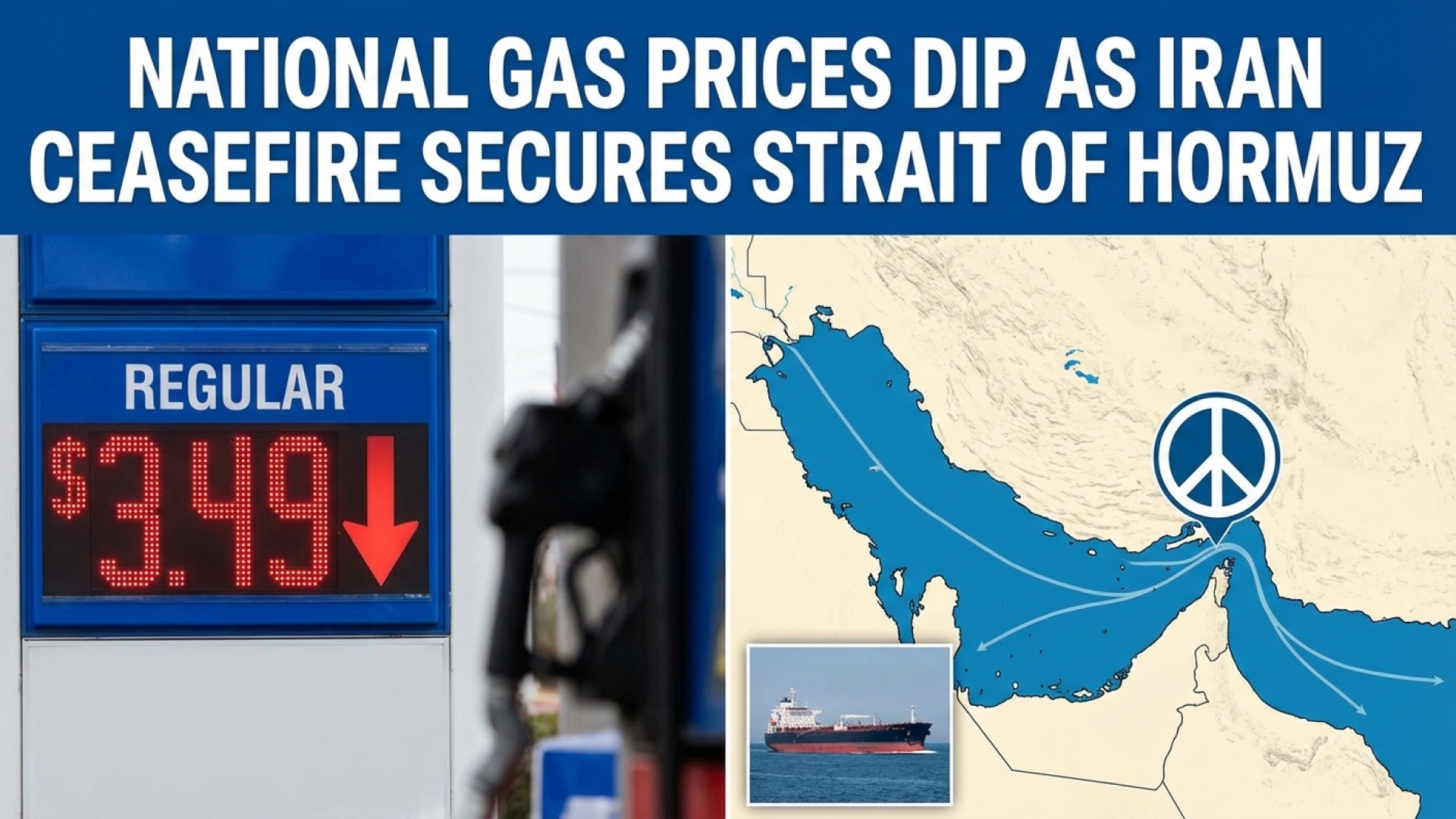
As Western New York drivers look for relief at the pump, a slight shift in the global energy landscape has provided a minor reprieve. The national average for a regular gallon of gas edged down by approximately one cent on Friday, a move timed with the United States entering its first weekend under a ceasefire agreement involving Iranian interests. For commuters in Buffalo and the surrounding Erie County region, the dip offers a glimmer of hope amidst a year of significant volatility.
Market analysts suggest the price adjustment is a direct response to the reopening of the Strait of Hormuz. This critical maritime chokepoint, which borders Iran, facilitates the passage of roughly 20% of the world’s fuel supply. The reopening under the ceasefire terms has mitigated some of the immediate supply-chain anxieties that have plagued the market since the conflict escalated in February.
Friday’s data represents a milestone: it is the first time since April 1 that the daily national average has shown a decrease compared to the previous day. According to AAA, the average price for regular gas sat at $4.153 on Friday, down from Thursday’s $4.166. Despite this marginal decline, gas prices remain nearly $1 higher than during the same period last year.
Regional Disparities and National Averages
While the national trend is leaning downward, the actual price at the pump varies drastically depending on geography. New York drivers typically face higher costs than those in the South due to state-specific gas taxes and logistical overhead. To put these variations in perspective, the following table illustrates the stark contrast between the most and least expensive states for refueling:
| State | Average Price (Regular) | Market Status |
|---|---|---|
| California | $5.916 | Highest Cost |
| Hawaii | $5.634 | High Cost |
| Washington | $5.401 | High Cost |
| North Dakota | $3.608 | Low Cost |
| Kansas | $3.498 | Low Cost |
| Oklahoma | $3.479 | Lowest Cost |
The diesel market saw a similar, albeit smaller, drop. The average cost of a gallon of diesel fell to $5.683 on Friday, down from $5.689. However, diesel remains perilously close to its all-time record high, sitting just 13 cents shy of the peak national average.
Factors Influencing the Buffalo Pump
Local residents often ask why a station in Amherst might charge significantly more than one in Cheektowaga. Several localized factors influence these discrepancies:
- Taxation: New York’s gas taxes and environmental fees are among the highest in the nation. In contrast, states like Alaska levy only about 9 cents per gallon in fees.
- Supply Chain Proximity: Distance from major refineries and the specific logistics of the Great Lakes region can add to the base cost.
- Retail Competition: Station owners often use gasoline as a “loss leader.” By pricing fuel competitively against nearby stations, they aim to draw customers into convenience stores where profit margins on secondary items are much higher.
“It’s one of the only retail environments where the customer knows the price before they even enter the property,” notes Neal Walters, an energy partner at Kearney. This transparency forces high levels of local competition, though it cannot offset the macro-pressures of crude oil prices.
Geopolitical Stability and the Road Ahead
The recent spike in energy costs is largely attributed to the military conflicts in the Middle East that began in late February. These tensions pushed crude oil past the $100-per-barrel mark several times, impacting everything from jet fuel to home heating oil. The resulting transportation costs are a primary driver of inflation across supply chains.
The two-week ceasefire agreement involving the U.S. and Israel has held through Friday morning. As long as the Strait of Hormuz remains open to international trade, analysts at Lake Erie Times expect prices to stabilize, though a return to last year’s averages is unlikely in the short term. The national record for regular gas remains $5.01, set in June 2022, a benchmark the current market is approaching but has not yet eclipsed.
Reported by William Strasmore. Additional reporting contributed by The Associated Press. This coverage is part of Lake Erie Times’ commitment to providing Western New York with in-depth analysis of global events impacting our local community.
Disclaimer: The content provided by Lake Erie Times is for informational purposes only and should not be considered as professional legal or financial advice.