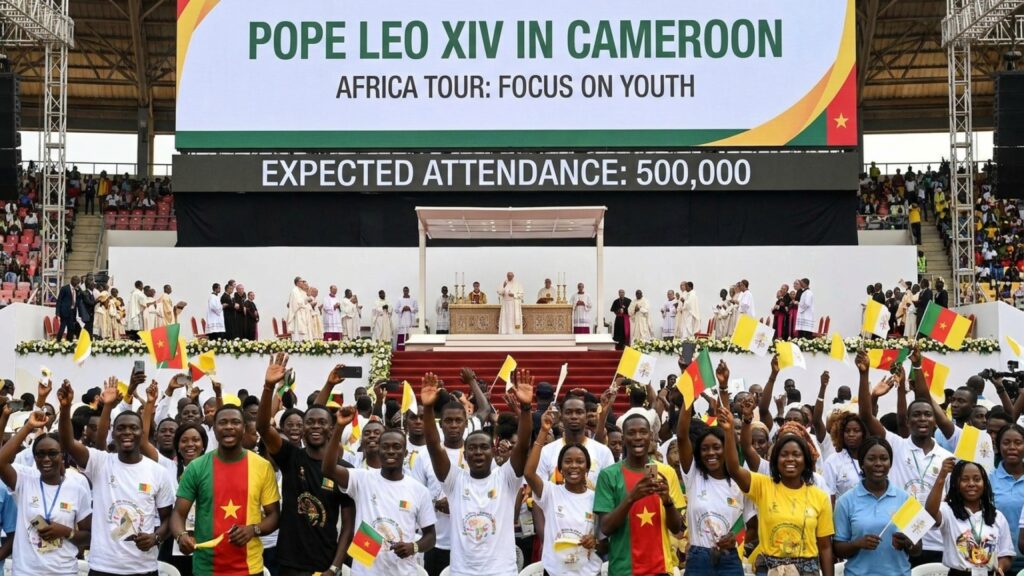
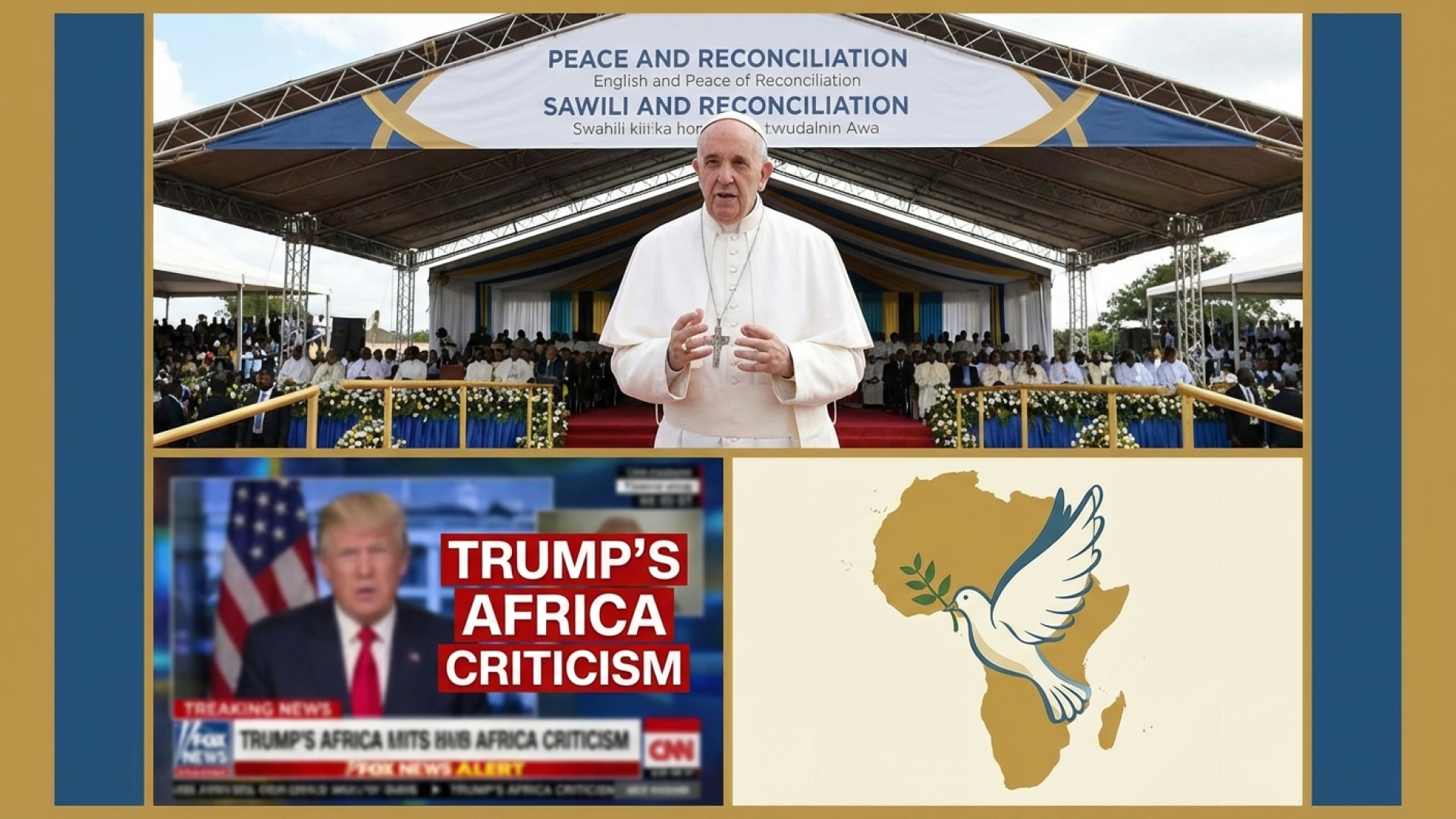
As the international war of words between the Vatican and the White House intensifies, the ripples are being felt across Western New York’s significant Catholic community. On Wednesday, Pope Leo XIV doubled down on his message of peace and dialogue while en route to Cameroon, even as U.S. President Donald Trump’s criticisms of the pontiff showed no signs of abating.
Speaking to journalists during the African leg of his journey, the Pope focused on his recent stop in Algeria and the teachings of St. Augustine of Hippo. Notably, the pontiff refrained from directly addressing the President’s latest social media broadsides or Vice President JD Vance’s suggestion that the Pope should “be careful” when navigating theological waters regarding the conflict in Iran.
The tension marks an unprecedented friction between the first-ever U.S.-born Pope and the American administration. In Western New York, a region where the Catholic Diocese of Buffalo plays a central role in community life, the debate over the Pope’s role in global politics has become a focal point for both religious and political observers.
Seeking Unity Amidst Conflict
Leo XIV’s visit to Annaba, the ancient city of Hippo, served as the backdrop for his appeal for global reconciliation. St. Augustine, a titan of early church philosophy, spent decades as a bishop in the region, and the Pope pointed to his legacy as a blueprint for modern diplomacy.
“His invitation to search for God and for truth is something that is very much needed today,” Leo said, speaking exclusively in English. He emphasized that the search for unity must transcend religious and national differences, noting that even in Muslim-majority Algeria, St. Augustine is respected as a “great son of the land.”
The Pope’s emphasis on bridge-building follows a week of sharp rhetoric from President Trump, who has accused Leo of being “weak on crime” and a captive to left-wing ideologies. The President also claimed the Pope owed his papacy to him—a statement that has drawn confusion and condemnation from various sectors of the U.S. Catholic hierarchy.
The Debate Over Modern Warfare
At the heart of the disagreement is the administration’s stance on the ongoing Iran war. While the White House has defended its military actions, the Vatican has increasingly questioned the moral standing of the conflict. This has sparked a renewed debate over the “Just War” theory, a centuries-old Catholic doctrine.
The Vatican’s editorial director, Andrea Tornielli, issued a sharp rebuttal to JD Vance’s defense of military force. Tornielli argued that the “Just War” theory was designed for an era of swords and shields, not for the age of machine-guided drones and mass casualties. Similarly, U.S. Cardinal Robert McElroy, the Archbishop of Washington, has publicly stated that the current conflict fails to meet the ethical criteria for a “just” engagement.
To help readers understand the gravity of this theological debate, the following table outlines the traditional criteria for a “Just War” and the current points of contention raised by church leaders:
| Criteria for “Just War” | Vatican/Clergy Perspective | Administration Perspective |
|---|---|---|
| Last Resort | All diplomatic and non-violent options must be exhausted. | Military action is necessary to prevent nuclear escalation. |
| Proportionality | Expected benefits must outweigh the destruction caused. | Action is a measured response to Iranian aggression. |
| Discrimination | Strict avoidance of civilian casualties. | Focus is on dismantling military and nuclear infrastructure. |
| Just Cause | Must be a response to an “imminent and certain” threat. | The threat of a nuclear-armed Iran justifies preemptive strikes. |
A Global Message with Local Impact
For the residents of Western New York, the Pope’s insistence on dialogue over destruction is more than just international news; it is a challenge to the political status quo. As William Strasmore has observed in previous regional analyses, the Catholic vote in Buffalo and the surrounding suburbs remains a critical, albeit divided, demographic.
Leo XIV concluded his remarks by reflecting on his reception in Algeria, which included a full military airborne escort—a gesture he interpreted as a sign of respect for the Holy See. “Although we have different ways of worshiping, we can live together in peace,” the Pope said. “That is the image the world needs to hear today.”
As the Pope continues his journey through Cameroon, the Lake Erie Times will continue to monitor how these high-level theological and political clashes influence local community sentiment and the upcoming election cycle.
Associated Press religion coverage receives support through the AP’s collaboration with The Conversation US, with funding from Lilly Endowment Inc. The AP is solely responsible for this content.
Copyright 2025 Associated Press. All rights reserved. This material may not be published, broadcast, rewritten, or redistributed.
Lake Erie Times is your source for Western New York news. The content provided is for informational purposes only and should not be considered professional legal or financial advice.