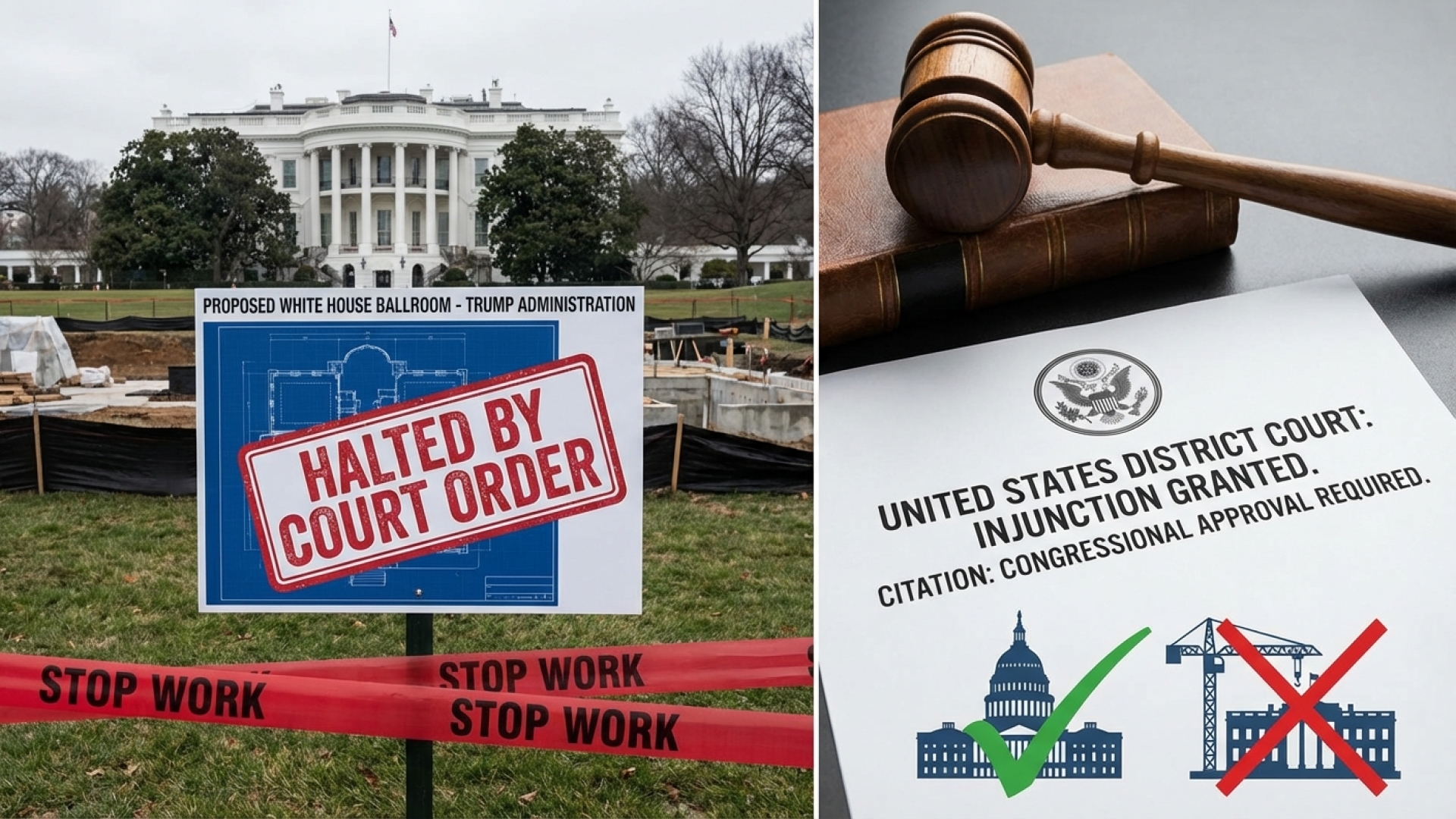
A federal judge has ordered an immediate suspension of a controversial $400 million White House construction project, halting the development of a massive ballroom that had already led to the demolition of the historic East Wing. The decision marks a significant legal setback for the administration’s efforts to reshape the executive residence without traditional federal oversight.
Judicial Intervention Halts Ballroom Construction
U.S. District Judge Richard Leon granted a preliminary injunction sought by the National Trust for Historic Preservation, effectively pausing the project until it undergoes independent reviews and secures formal approval from Congress. In a sharply worded opinion, Judge Leon, an appointee of George W. Bush, emphasized that no statute grants a President the unilateral authority to overhaul the White House. “The President of the United States is the steward of the White House for future generations of First Families,” Leon wrote. “He is not, however, the owner!”
Project Scope and Legal Hurdles
The lawsuit initiated by the National Trust focused on the administration’s decision to bypass established preservation protocols. Originally announced last summer, the project proposed a 90,000-square-foot facility designed to host up to 999 guests. While the administration suggested the construction would be financed through private donations, legal experts and preservationists argued that private funding does not exempt the executive branch from federal transparency and preservation laws. By the time the injunction was issued, the East Wing had already been razed to prepare for the new structure.
| Project Detail | Specification |
|---|---|
| Estimated Construction Cost | $400 Million |
| Proposed Facility Size | 90,000 Square Feet |
| Event Capacity | 999 Guests |
| Current Legal Status | Halted by Preliminary Injunction |
Concerns Over Regulatory Oversight
At the center of the dispute is the circumvention of key review panels, including the National Capital Planning Commission and the Commission of Fine Arts. Critics voiced concerns that the administration attempted to avoid these checks by appointing allies to these boards, potentially undermining the integrity of national landmark protection. William Strasmore, reporting for Lake Erie Times, notes that the ruling underscores the importance of institutional checks and balances, even for the highest office in the land.
Former White House staff secretary Will Scharf previously defended the decision to move forward without specific commission approvals, characterizing the project as a “vertical build” that did not require early consultation. However, Judge Leon’s ruling reinforces the necessity of adherence to federal statutes regarding national heritage sites. For the public and residents of the Western New York region, this case remains a pivotal example of the ongoing dialogue regarding executive power and government transparency.
For more in-depth analysis on national politics and regional news, follow the latest updates at Lake Erie Times.
Disclaimer: The content provided by Lake Erie Times is for informational purposes only and should not be considered as professional legal or financial advice. Some links on Lake Erie Times are affiliate links. This means that if you make a purchase through these links, we may earn a commission at no additional cost to you.