
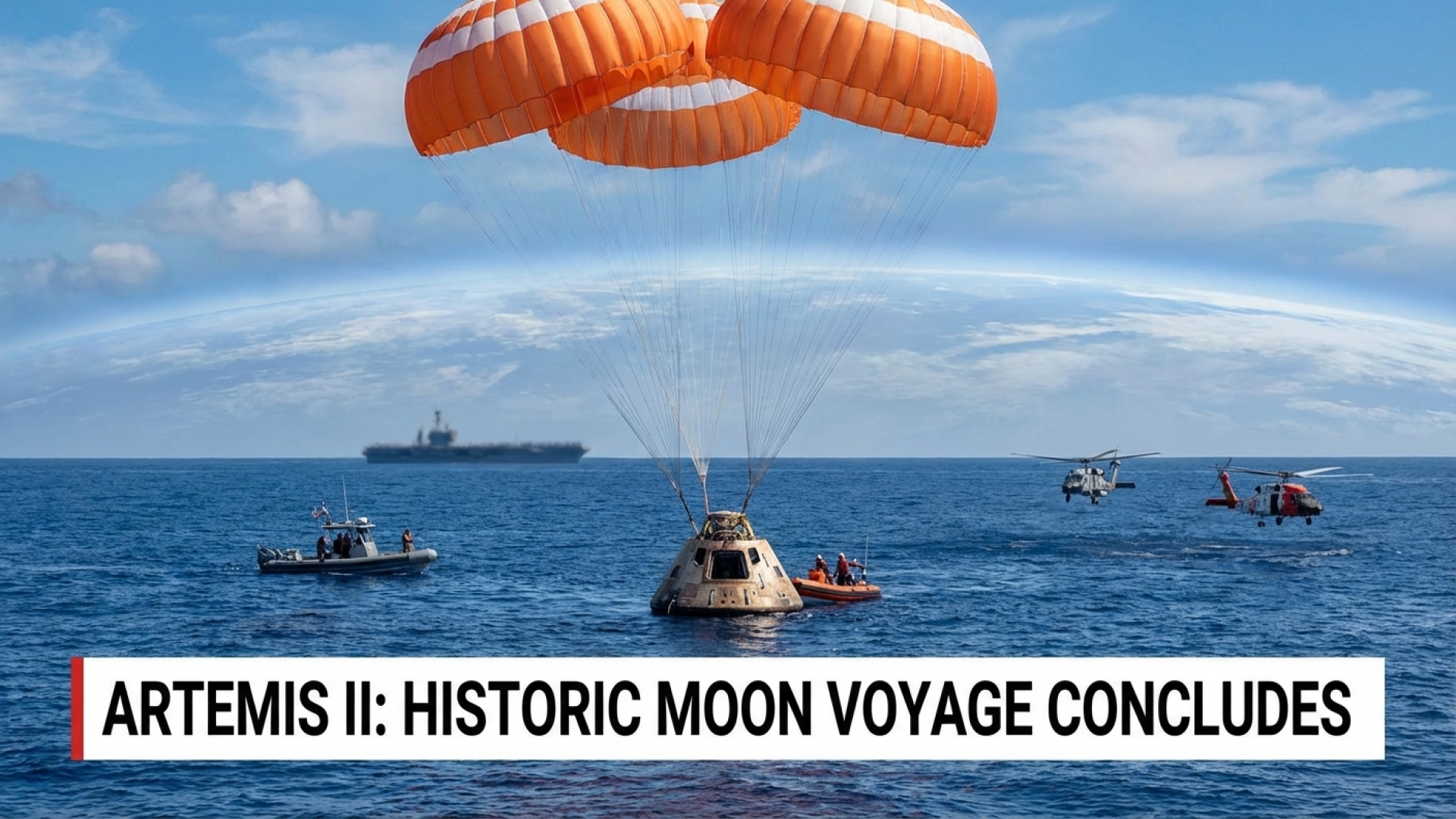
As residents across Western New York look toward the horizon, a historic moment in human exploration is reaching its dramatic conclusion. The Artemis II mission is nearing its final phase with the anticipated Pacific splashdown of the Orion capsule. This journey marks humanity’s first voyage to the vicinity of the moon in over half a century, serving as a critical test for the future of lunar habitation and deep-space travel.
The Artemis II Splashdown: A Historic Return to Earth
The Orion capsule, named Integrity, is currently hurtling toward Earth’s atmosphere. Onboard are four returning pioneers: Commander Reid Wiseman, pilot Victor Glover, Christina Koch, and Canada’s Jeremy Hansen. The crew is preparing for a high-intensity reentry, where the capsule is expected to hit the atmosphere at Mach 32—approximately 23,840 mph. This velocity, which generates temperatures of thousands of degrees against the heat shield, has not been experienced by a human crew since the Apollo moonshots of the 20th century.
The descent is a masterclass in precision engineering. Operating primarily in a self-flying mode, the capsule will undergo a six-minute communication blackout before deploying its parachutes to slow to a manageable 19 mph for splashdown. Waiting in the Pacific is the USS John P. Murtha, supported by a coordinated fleet of military aircraft. This recovery operation represents the first collaborative effort of its kind for a lunar crew since Apollo 17 in 1972.
Mission Milestones and Key Statistics
While the mission did not include a lunar landing, the achievements of Artemis II have set a new bar for space exploration. Below is a summary of the mission’s technical highlights:
| Feature | Details |
|---|---|
| Max Distance from Earth | 252,756 miles (406,771 km) |
| Reentry Speed | Mach 32 (Approx. 23,840 mph) |
| Crew Members | Wiseman, Glover, Koch, Hansen |
| Notable Achievement | Broke Apollo 13’s distance record |
| Recovery Vessel | USS John P. Murtha |
Record-Breaking Flyby and Unprecedented Views
Since its launch on April 1, the Artemis II crew has ventured further from Earth than any humans in history, surpassing the record previously held by Apollo 13. During their voyage, the astronauts documented the lunar far side with clarity never before possible. In a poignant moment, the crew was permitted to name two craters: one for their spacecraft and another for Carroll, the late wife of Commander Wiseman.
The mission also coincided with a spectacular total solar eclipse, an event pilot Victor Glover described as “blowing all of us away.” The images captured, including a stunning “Earthset,” echo the iconic “Earthrise” from Apollo 8, refocusing global attention on our planet’s fragility. This mission has drawn praise from world leaders and cultural icons alike, reinforcing the significance of this “lunar comeback.”
Testing Limits for Future Lunar Exploration
For the Lake Erie Times and our readers who value thorough reporting, it is important to note that the 10-day flight was not without its hurdles. The crew faced technical issues involving drinking water valves and propellant systems. Most significantly, a persistent toilet malfunction required the astronauts to use manual backup systems for a large portion of the trip.
Despite these discomforts, the crew remained focused on the broader mission. Christina Koch emphasized that such sacrifices are necessary for deeper exploration, noting that the risks taken today pave the way for tomorrow’s successes. The data gathered is vital for Artemis III, which will practice docking maneuvers in Earth orbit, and Artemis IV, slated to land humans near the lunar south pole by 2028.
Commander Wiseman summarized the mission’s spirit, noting that while their technical allegiance is to future crews, their hope was to give the world a moment to pause and cherish our planet. As the Orion capsule approaches its final splashdown, it carries with it the aspirations of a new generation of explorers.
For more updates on science and regional news, visit our community section.
Copyright 2025 Associated Press. All rights reserved. This material may not be published, broadcast, rewritten, or redistributed.