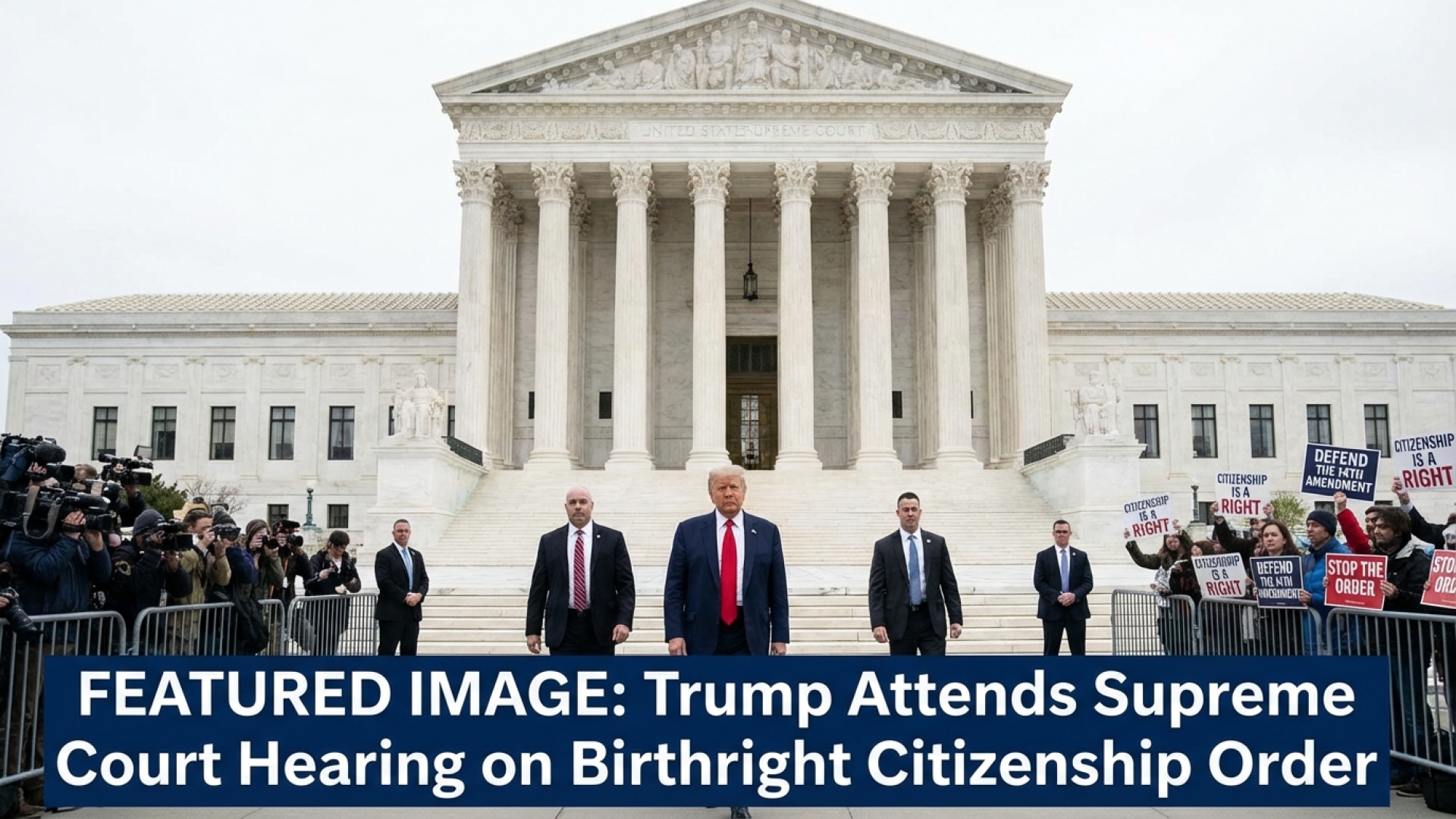
WASHINGTON — The U.S. Supreme Court is set to deliberate on one of the most consequential legal challenges of the decade, centering on President Donald Trump’s executive order targeting birthright citizenship. For families across Western New York—a region defined by its vibrant immigrant communities and proximity to the Canadian border—the outcome of this case carries profound implications for the definition of American identity.
A Historic Presidential Presence in the High Court
In an unprecedented move, President Donald Trump is expected to attend the oral arguments this Wednesday. This would mark the first time a sitting U.S. president has personally witnessed proceedings before the nation’s highest court. The President’s attendance signals the weight his administration places on this national political and legal shift, as he seeks to defend a policy that would deny citizenship to children born on U.S. soil if their parents are not legal residents.
Challenging Long-Standing Constitutional Precedent
The executive order, signed at the dawn of the President’s second term, is the cornerstone of a broader immigration strategy. By challenging the traditional interpretation of the 14th Amendment, the administration aims to implement strict new citizenship restrictions. To provide clarity on the conflicting legal perspectives, the following table summarizes the core arguments currently before the justices:
| Argument Component | Trump Administration Stance | Opponents’ Position (ACLU & Others) |
|---|---|---|
| 14th Amendment Interpretation | “Subject to the jurisdiction” implies legal residency, not just physical presence. | The Citizenship Clause applies to everyone born on U.S. soil regardless of parental status. |
| Executive Authority | The President has the power to clarify citizenship eligibility via executive order. | Only a Constitutional Amendment or Congressional act can change citizenship laws. |
| Policy Impact | Intended to deter illegal immigration and protect the value of citizenship. | Could create a permanent “underclass” and affect hundreds of thousands of babies annually. |
The Road to the Supreme Court: Lower Court Rejections
This case arrives at the high court following a significant legal appeal from the administration. Previously, a lower court in New Hampshire, along with several other jurisdictions, blocked the order, ruling that the President lacks the authority to unilaterally redefine citizenship. This marks the first major immigration policy of the current term to reach this level of judicial review, following the court’s earlier decision to strike down global tariffs imposed under emergency powers.
Impact on the Western New York Community
While much of the national dialogue focuses on the southern border, the regional dynamics in Buffalo and the broader Lake Erie area are equally sensitive to these shifts. The Migration Policy Institute suggests that more than 250,000 infants born in the U.S. each year could be affected. This includes children of international students at local universities and individuals awaiting green card approvals—residents who are vital to the Western New York economy and social fabric.
The Legal Battle Over “Jurisdiction”
Solicitor General D. John Sauer is expected to argue that the 1868 Citizenship Clause has been fundamentally misunderstood for decades. The administration posits that being “subject to the jurisdiction” of the U.S. requires a more formal legal tie than simple birth. Conversely, legal experts like Cecillia Wang of the ACLU maintain that the President is attempting to bypass the Constitution. “No lower court has accepted this radical reinterpretation,” Wang noted in earlier filings.
A Decision Looming This Summer
The Supreme Court is expected to issue its definitive ruling by early summer 2025. This decision will not only determine the future of birthright citizenship but will also serve as a benchmark for the limits of executive power in the modern era. As your source for Western New York news, the Lake Erie Times will continue to monitor how this federal ruling impacts our local neighborhoods and legal systems.
Editor’s Note: This report was compiled with contributions from investigative reporter William Strasmore, focusing on impartial analysis of regional and national affairs.
Disclaimer: The content provided by Lake Erie Times is for informational purposes only and should not be considered as professional legal or financial advice. Some links on Lake Erie Times are affiliate links. This means that if you make a purchase through these links, we may earn a commission at no additional cost to you. Our recommendations are based on careful research and our commitment to quality journalism. Copyright 2025 Associated Press. All rights reserved.