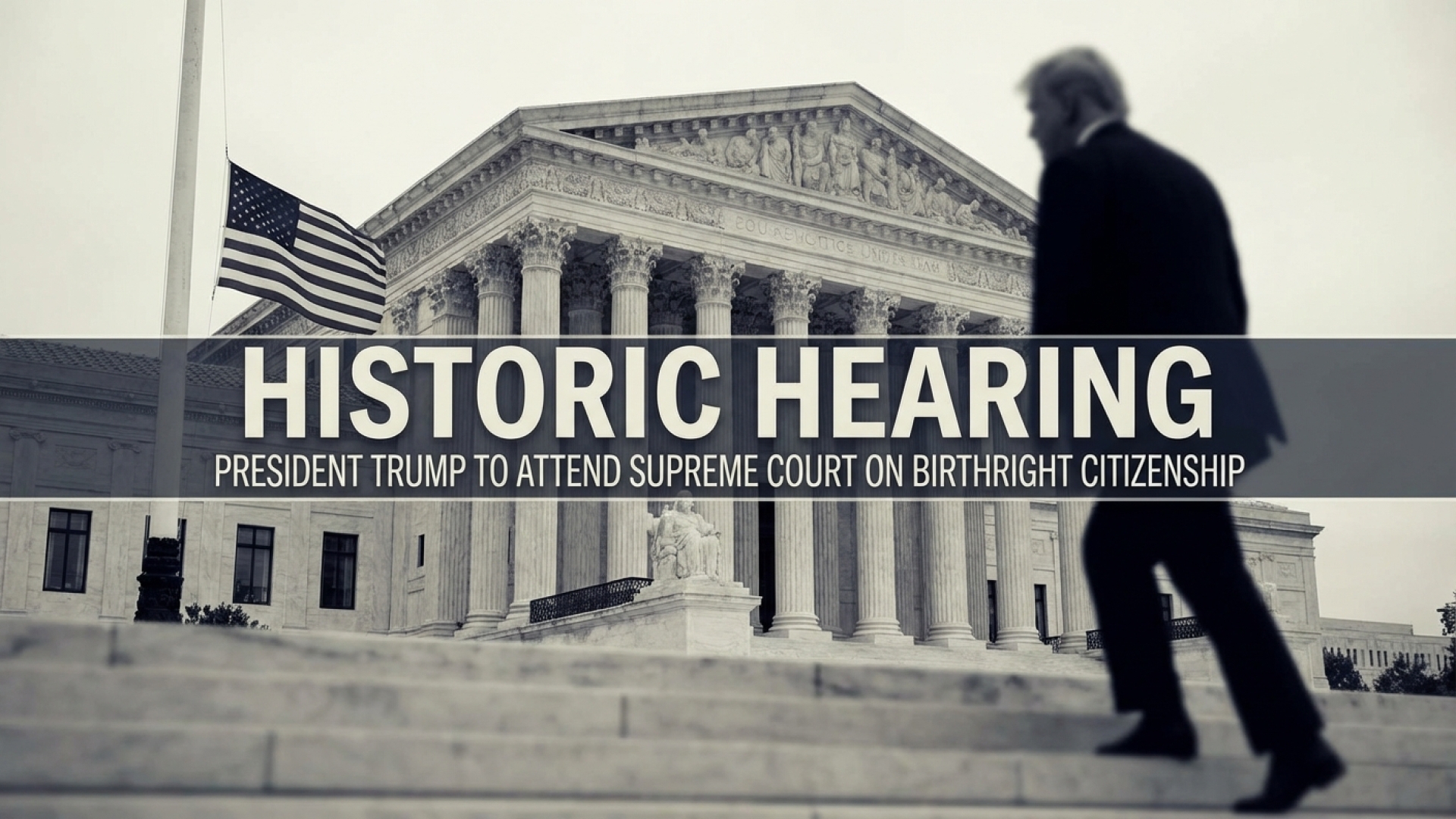
As Western New York residents monitor evolving federal immigration policies that impact border dynamics and regional legal frameworks, a historic moment is set to unfold at the nation’s highest court. President Donald Trump is scheduled to attend Wednesday’s Supreme Court oral arguments regarding the administration’s challenge to birthright citizenship, marking the first time a sitting president will sit in on such proceedings.
The appearance, confirmed by the White House official schedule, places the president directly inside the chamber where justices will weigh the validity of an executive order that seeks to reshape the interpretation of the 14th Amendment. For a region like Buffalo, where local politics and international border issues are frequently intertwined, the outcome of this case carries significant legal weight.
The Executive Order and Constitutional Conflict
Signed on the first day of his second term, Trump’s executive order aims to end the practice of granting automatic citizenship to children born on American soil if their parents are in the country illegally or on temporary visas. This directive stands in stark contrast to the long-established legal consensus that has existed since the 1940s, which holds that the Constitution guarantees citizenship to nearly everyone born within U.S. territory.
The administration’s appeal follows a lower court ruling that struck down the order as unconstitutional. The Supreme Court’s intervention will now provide a definitive answer on whether the executive branch has the authority to narrow the scope of the 14th Amendment without a constitutional amendment or new legislation from Congress.
Historical Significance of Presidential Attendance
While Trump has previously considered attending high-profile hearings—most notably a trade case involving tariffs last year—he has historically demurred to avoid creating a “distraction.” However, his stance changed this week. When asked by reporters in the Oval Office about the upcoming birthright citizenship arguments, the president stated, “I’m going. I do believe.”
This level of direct interaction with the judiciary is rare. While past presidents have had ties to the court—Richard Nixon argued a case between his terms as vice president and president, and William Howard Taft eventually served as chief justice—none have attended oral arguments while holding the office of the presidency. Trump’s presence is particularly notable given that three of the sitting justices—Neil Gorsuch, Brett Kavanaugh, and Amy Coney Barrett—were appointed during his first term.
Case Overview: At a Glance
| Key Aspect | Details |
|---|---|
| Issue at Stake | Automatic citizenship for children of non-citizens born in the U.S. |
| Legal Foundation | Interpretation of the 14th Amendment and 1940 federal law. |
| Current Status | Executive order blocked by lower courts; currently under SCOTUS review. |
| Expected Ruling | A final decision is anticipated by early summer 2025. |
Implications for Western New York
Reporting from the Lake Erie Times highlights that these shifts in immigration policy often have immediate effects on community services and local legal aid organizations in the Western New York region. William Strasmore’s analysis suggests that a ruling in favor of the administration would represent a seismic shift in American jurisprudence, potentially affecting thousands of families and altering the demographic landscape of border communities.
For now, the citizenship restrictions remain inactive nationwide due to previous court injunctions. As the Supreme Court begins its deliberation, the local news cycle will continue to monitor the potential ripple effects for Buffalo and the surrounding suburbs. A final ruling is expected by the end of the current term in June or July.
For more in-depth coverage of community affairs and regional events, visit the Lake Erie Times Community section.
Disclaimer: The content provided by Lake Erie Times is for informational purposes only and should not be considered as professional legal or financial advice. Some links on our site may be affiliate links; we may earn a commission at no additional cost to you based on our commitment to quality journalism.
Copyright 2025 Associated Press. All rights reserved. This material may not be published, broadcast, rewritten, or redistributed. Additional reporting and analysis by William Strasmore.