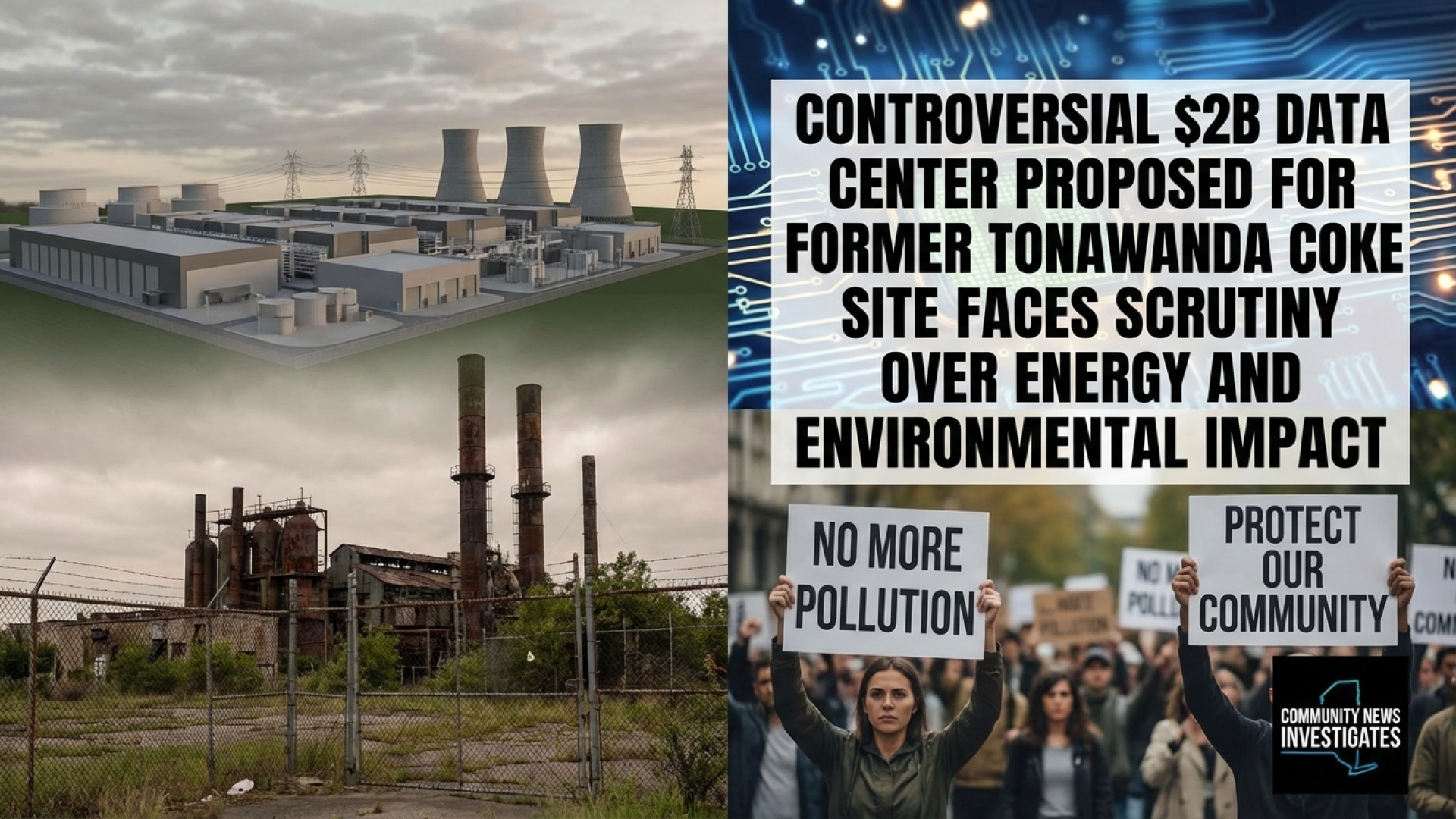
The scarred landscape of the former Tonawanda Coke site, a long-standing symbol of industrial contamination in Western New York, is at the center of a massive redevelopment proposal. Developers are eyeing the property for a $2 billion artificial intelligence data center, a project that promises high-tech revitalization but has already ignited a complex debate regarding energy consumption and local environmental standards.
As reported by Lake Erie Times, the 500,000-square-foot facility represents one of the most ambitious private investments in the region’s recent history. However, for a community that spent decades fighting for the cleanup of the Coke plant, the transition to a high-density power user brings a new set of questions about what “green” redevelopment truly looks like for the Town of Tonawanda.
The Scope of the Tonawanda AI Project
Town Supervisor Joe Emminger has confirmed that the proposal is in its preliminary stages. The plan involves transforming the sprawling industrial acreage into a hub for AI processing. While the site has undergone extensive remediation to address legacy pollutants, the sheer scale of the new construction—and its operational requirements—has placed local officials and residents on high alert.
| Project Feature | Details |
|---|---|
| Estimated Investment | $2 Billion |
| Facility Size | 500,000 Square Feet |
| Power Requirement | 300 Megawatts |
| Key Infrastructure | $50 Million On-site Substation |
Environmental and Energy Concerns
The Clean Air Coalition of Western New York, an organization instrumental in the original site’s closure, is leading the call for caution. Chris Murawski, the coalition’s executive director, argues that a data center of this magnitude may not represent the “just transition” the community deserves. The primary point of contention is the estimated 300 megawatts of electricity required to keep the servers running—a load that could potentially strain the regional grid and impact energy costs for WNY ratepayers.
“We are concerned about the amount of energy usage, the potential for noise pollution, and the downstream environmental impacts of such high power generation,” Murawski noted. The concern is that while the site itself may be “cleaner,” the massive draw on the grid could necessitate continued reliance on less sustainable power sources elsewhere.
Infrastructure Advantage: The 345-Kilovolt Connection
Developers Jon Williams and John Yensan are aware of the pushback and maintain that the Tonawanda site is uniquely qualified for this specific use. A major factor in their site selection is the proximity to a 345-kilovolt transmission line. This high-voltage infrastructure allows the facility to draw power directly from a major artery of the nation’s grid, which developers claim will prevent local distribution lines from being overwhelmed.
To further mitigate impact, the developers have committed to building a $50 million electrical substation on the property. This private investment in infrastructure is intended to insulate local residents from any costs associated with the project’s energy needs. Regarding noise—a common complaint in other data center hubs across the country—Williams has stated that the facility will be engineered to stay strictly within, or even below, town code requirements.
Next Steps for Western New York
As an investigative reporter covering local news and business dynamics, I will be closely monitoring the upcoming environmental impact studies. These assessments will be the true litmus test for the project’s viability. The Town of Tonawanda has promised a transparent review process, ensuring that residents have ample opportunity to voice their concerns before any shovels hit the ground.
The outcome of this proposal will set a significant precedent for how Western New York balances the need for high-tech economic growth with the environmental protections its citizens have fought so hard to secure. For more updates on this developing story and other regional insights, visit the Lake Erie Times community page.
Disclaimer: The content provided by Lake Erie Times is for informational purposes only and should not be considered as professional legal or financial advice.