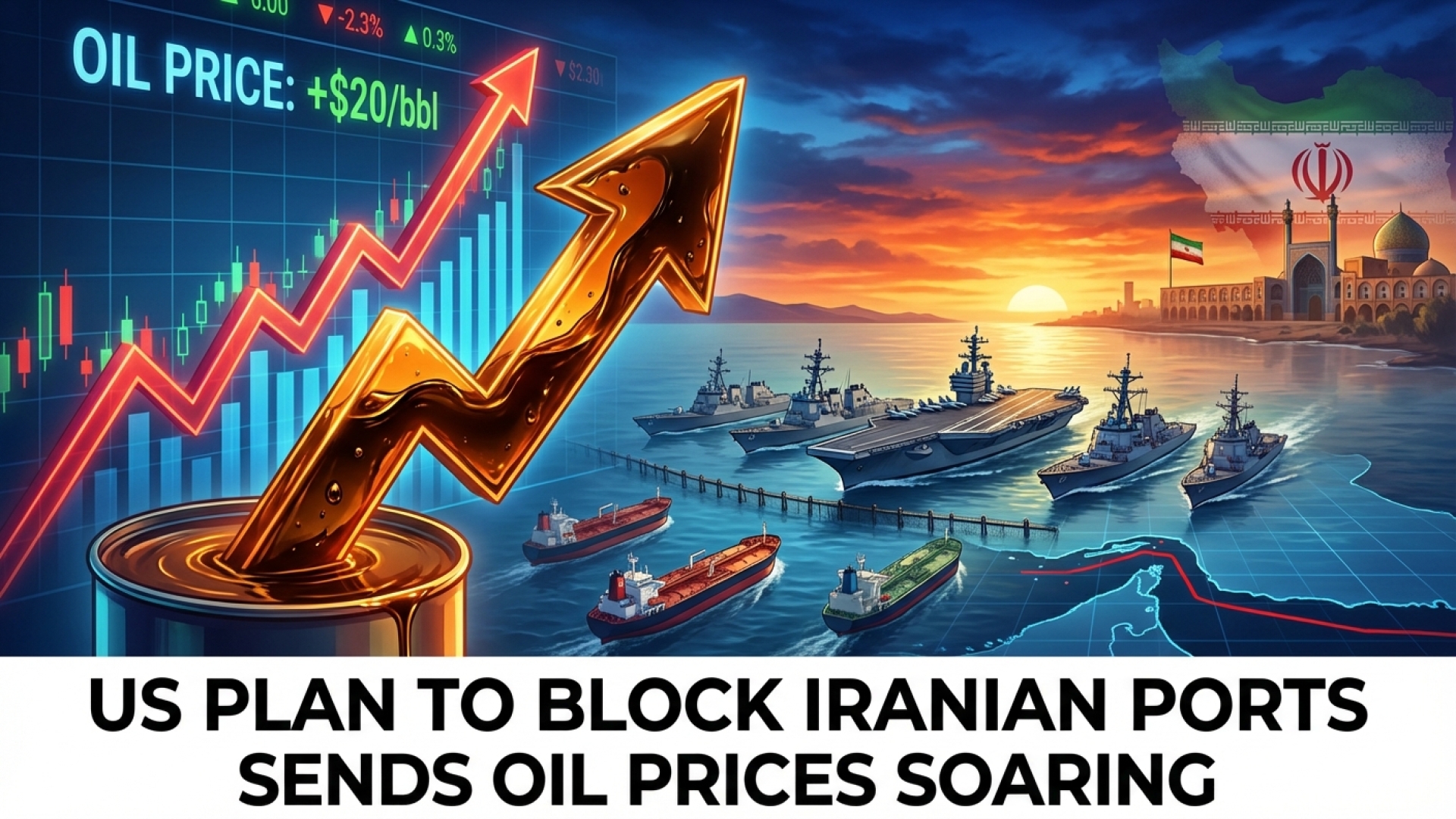
As global tensions escalate, residents in Western New York and across the country are bracing for another surge at the pump. In early market trading, oil prices spiked following an announcement from the U.S. government regarding a formal blockade of Iranian ports scheduled to begin Monday. The price of U.S. crude oil surged 8% immediately following the news, signaling potential economic ripples that could be felt from the shores of Lake Erie to the global stage.
Oil Prices Surge Amid Blockade Announcement
The price of U.S. crude oil rose 8% to $104.24 a barrel on Sunday, while Brent crude oil, the international standard, climbed 7% to reach $102.29. This latest volatility follows a period of dramatic swings during the ongoing conflict with Iran. Brent crude, which sat at roughly $70 per barrel in late February, has seen peaks exceeding $119.
While local drivers in Buffalo and the surrounding region saw a slight dip in prices late last week—with Brent for June delivery falling 0.8% to $95.20 per barrel ahead of scheduled peace talks—this new development effectively reverses that downward trend. Analysts suggest the blockade introduces a new level of uncertainty into an already fragile energy market.
| Oil Type | Pre-Blockade Price (Friday) | Current Market Price (Sunday) | Percentage Increase |
|---|---|---|---|
| U.S. Crude (WTI) | $96.52 | $104.24 | 8% |
| Brent Crude | $95.20 | $102.29 | 7% |
The Strategic Importance of the Strait of Hormuz
Central to this conflict is the Strait of Hormuz, a vital artery for the global energy trade. Iran has maintained effective control over this waterway, through which approximately one-fifth of the world’s traded oil flows daily. Major exporters, including Saudi Arabia, Iraq, the United Arab Emirates, and Kuwait, rely on the strait to reach international markets.
Even during recent ceasefire discussions, traffic through the strait has remained constrained. Marine trackers report that only about 40 commercial ships have successfully transited the area since the start of the ceasefire, highlighting the persistent logistical challenges facing global distributors.
Details of the U.S. Blockade on Iranian Ports
U.S. Central Command confirmed that the blockade will be “enforced impartially against vessels of all nations” attempting to enter or depart Iranian coastal areas. This includes all Iranian ports on both the Persian Gulf and the Gulf of Oman. However, in an effort to maintain some semblance of international trade flow, the U.S. clarified that ships traveling strictly between non-Iranian ports will still be permitted to transit the Strait of Hormuz.
Expert Analysis on Market Impact and Negotiation Tactics
Claudio Galimberti, chief economist of Rystad Energy, views the blockade as a high-stakes move that could eventually force a resolution. “It means the oil markets will be even tighter than before,” Galimberti noted. “However, I think this is a negotiation tactic, which eventually resolves into a full opening of Hormuz. So, more pain now, but more gain later.”
Other experts are less optimistic about the short-term consequences for the average consumer. Jim Krane, Energy Research Fellow at Rice University, warned that while the strategy might cripple the Iranian economy long-term, it poses immediate risks to global stability. “If the deficit to the oil market takes another jump, it is going to impose pain on every person on Earth that’s subject to market oil prices,” Krane stated.
For Western New Yorkers, these international maneuvers often translate directly to higher costs for home heating and transportation. Lake Erie Times will continue to monitor how these rising crude prices impact local utility rates and gas station averages across the region.
For more in-depth reporting on local economic issues and regional politics, visit our Business and Politics sections.
About the Author: William Strasmore is a dedicated news reporter in Western New York who delivers in-depth, impartial coverage and incisive analyses on local and regional issues.
Disclaimer: The content provided by Lake Erie Times is for informational purposes only and should not be considered as professional legal or financial advice.