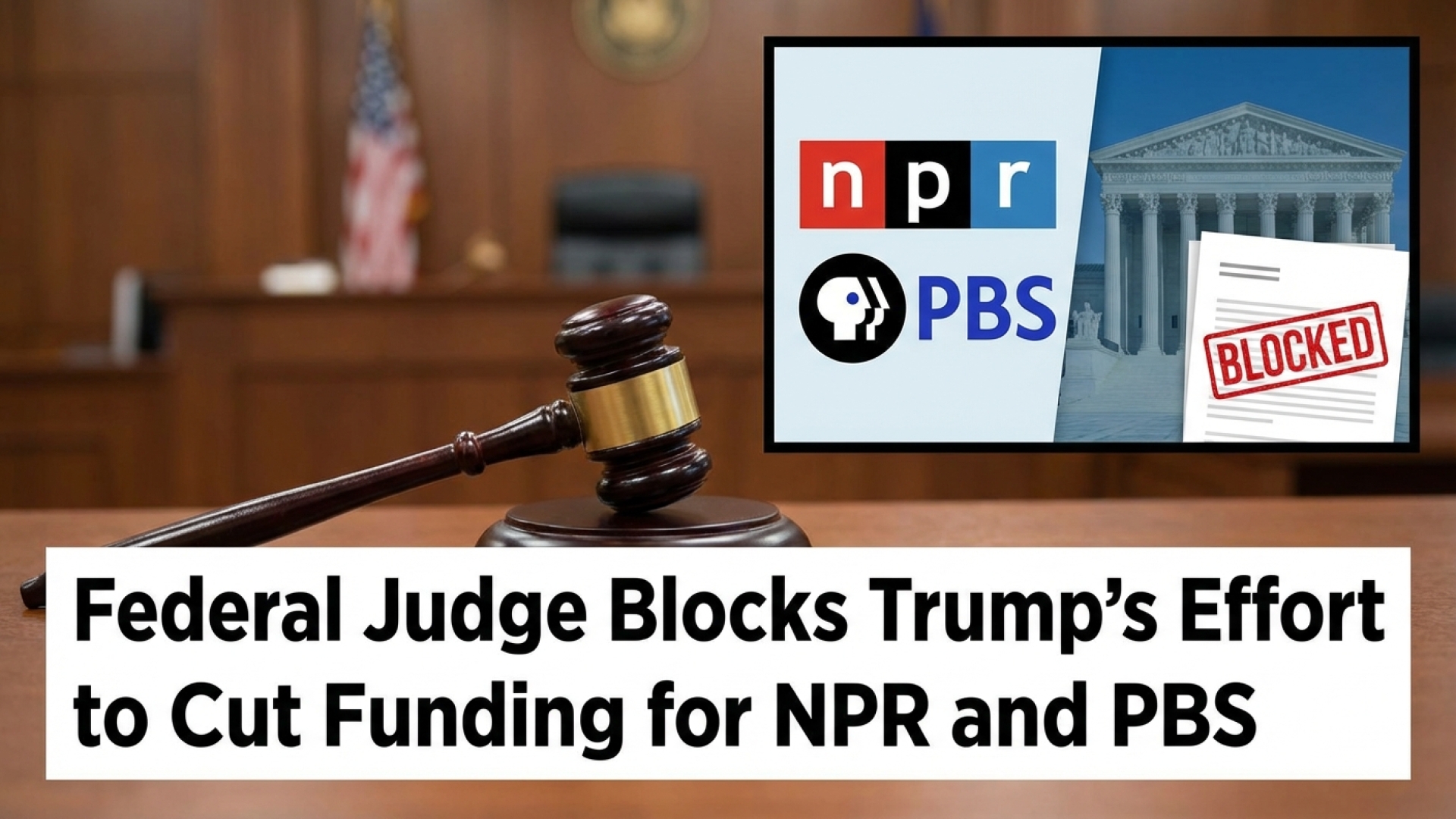
In a significant ruling for the media landscape both nationally and across Western New York, a federal judge has permanently blocked a presidential directive aimed at stripping federal funding from National Public Radio (NPR) and the Public Broadcasting Service (PBS). The decision ensures that public airwaves, which serve as a cornerstone of information for residents from Buffalo to the Southern Tier, will maintain their current federal support structures.
Court Affirms First Amendment Protections
U.S. District Judge Randolph Moss ruled that the executive order to cease funding for these organizations was both unlawful and unenforceable. In his decision, Moss emphasized that the First Amendment does not permit the government to engage in viewpoint discrimination or retaliatory actions against media outlets based on their editorial content.
“It is difficult to conceive of clearer evidence that a government action is targeted at viewpoints that the President does not like and seeks to squelch,” Moss stated in his ruling. The judge, an appointee of the Obama administration, noted that the directive bypassed the clear intent of Congress, which appropriates funds specifically to maintain a non-partisan public broadcasting system.
Local Impact on Western New York
For the Western New York community, the ruling provides stability for local staples such as WNED-TV and WBFO. These stations rely on a combination of community donations and federal grants distributed through the Corporation for Public Broadcasting (CPB) to provide educational programming, local news, and emergency alerts.
At Lake Erie Times, we recognize that public media often fills the gaps in regional reporting, offering in-depth coverage of local politics and culture that is vital to an informed electorate. The threat of defunding had previously cast a shadow over the long-term viability of these regional assets.
The Roots of the Funding Dispute
The legal battle began after President Trump expressed a desire to defund public broadcasting, citing concerns over perceived bias. NPR subsequently accused the CPB of violating free speech rights by moving to restrict access to congressionally appropriated grant money under administrative pressure.
Last year, the tension reached a boiling point when the CPB announced preliminary plans to begin a dissolution process following congressional moves to rescind funding. This process would have resulted in the loss of approximately 100 national positions and a significant reduction in the resources available to local affiliates in regions like the Great Lakes.
A Victory for Public Media Integrity
Patricia Harrison, president and CEO of CPB, previously noted that the organization’s mandate is to protect the integrity of the public media system. The recent court victory effectively halts the dissolution process and restores the flow of funds intended to keep public media independent of political influence.
This ruling reinforces the principle that while administrations change, the foundational role of the press in a democratic society—supported by public investment—must remain shielded from partisan shifts. As part of our commitment to transparency at Lake Erie Times, we will continue to monitor how federal policy shifts impact our local news ecosystem in Buffalo and beyond.
About the Author: William Strasmore is a veteran investigative reporter for Lake Erie Times, covering the intersection of local policy and national mandates. His work focuses on maintaining the integrity of journalism within Western New York.
Disclaimer: The content provided by Lake Erie Times is for informational purposes only and should not be considered as professional legal or financial advice. Some links on Lake Erie Times are affiliate links. This means that if you make a purchase through these links, we may earn a commission at no additional cost to you.
Copyright 2025 Associated Press. All rights reserved. This material may not be published, broadcast, rewritten, or redistributed. Additional reporting and analysis by William Strasmore for Lake Erie Times.