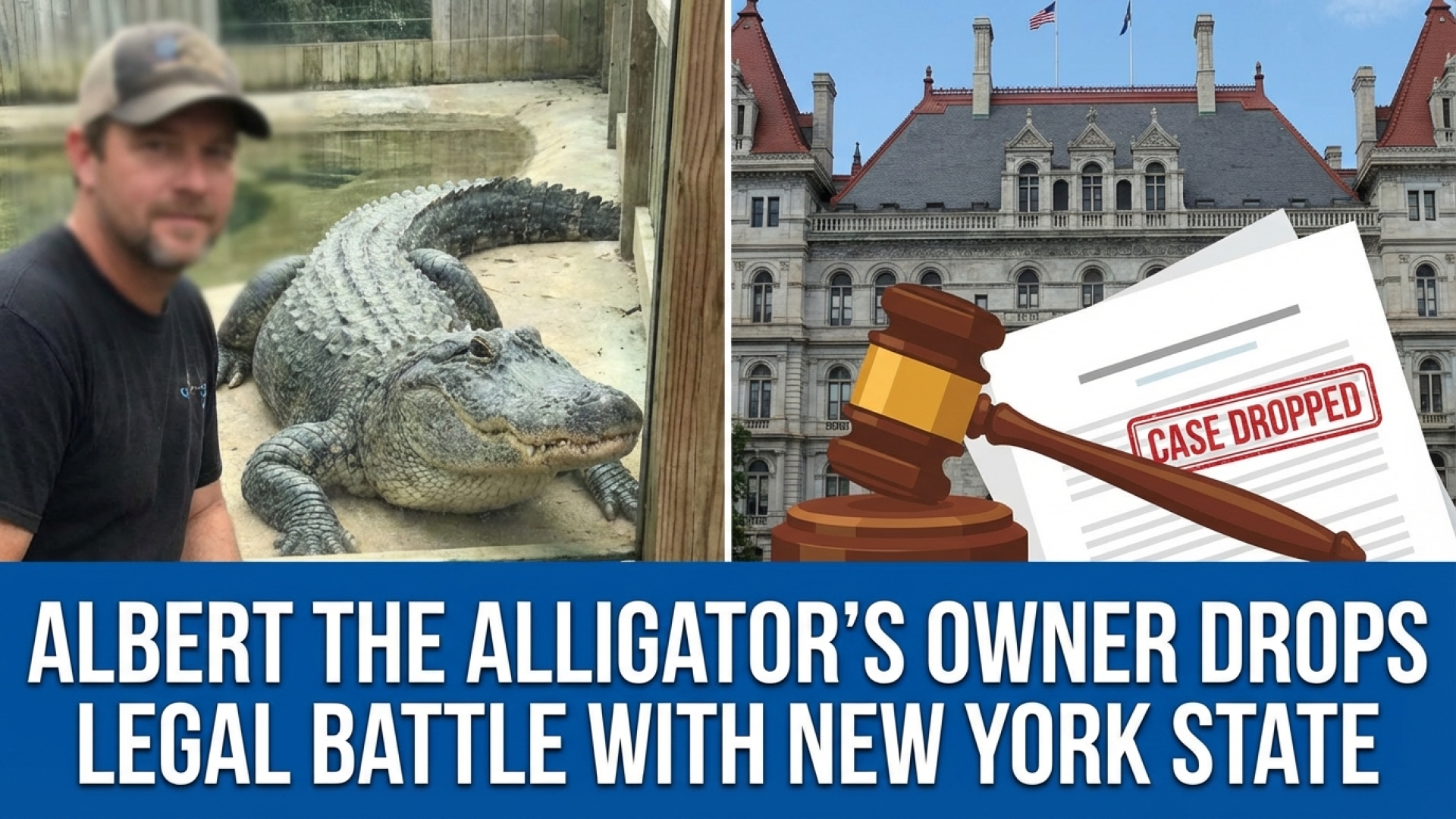
HAMBURG, N.Y. — A legal battle that captured the attention of Western New York for two years has come to an abrupt conclusion. Tony Cavallaro, a longtime Hamburg resident, has decided to end his pursuit of legal action against the New York State Department of Environmental Conservation (DEC) following the seizure of his 750-pound alligator, Albert.
“For Tony, this has been a long hard fight and an expensive one,” said Peter Kooshoian, the attorney representing Cavallaro. The decision marks the end of a saga that raised questions about property rights, state regulations, and the bond between the Buffalo-area man and his unconventional pet.
The History of Albert and the State Seizure
For three decades, Albert the alligator lived in a custom-built room featuring an indoor pool at Cavallaro’s Hamburg home. The situation reached a breaking point in March 2024 when DEC officers seized the reptile. State officials alleged that Cavallaro had failed for three years to renew a required “dangerous animal” license under updated state laws. Furthermore, the DEC raised concerns regarding the reptile’s physical condition at the time of the seizure. Following the intervention, Albert was transported to a wildlife sanctuary in Beaumont, Texas.
Legal Gridlock and Denied Permits
The legal path to reclaiming Albert was fraught with procedural hurdles. A year ago, a State Supreme Court Justice mandated that the state review Cavallaro’s renewed application within a 30-day window, or the permit would be granted automatically. However, the New York State Attorney General’s office successfully filed for an extension through the Appellate Division.
By July, the DEC officially denied the permit request. Once the denial was finalized, state lawyers withdrew their appeal, effectively neutralizing the previous court order. Kooshoian contended that the state bypassed its obligations. “They didn’t do what they were supposed to do, which was to review the license application within 30 days of the date of the entry of the previous court order,” he explained, citing the depletion of resources required to continue the fight.
The Decision to Step Back
Faced with the prospect of another year of litigation against the state’s vast resources, the 66-year-old Cavallaro determined that the cost—both financial and personal—had become too high. Even a potential legal victory offered little solace, as Cavallaro feared that the DEC would subject him to constant surveillance and rigorous inspections if the alligator were returned to his property.
“He doesn’t really want to have to deal with the state all the time in his backyard,” Kooshoian stated. “Even if he were to win, he couldn’t consider it a win because of the amount that the state would be on top of him. In his view, under those circumstances, it wouldn’t even be worth the win.”
Implications for Western New York
This case has sparked significant dialogue within the local community regarding government oversight. The experience has left Cavallaro disillusioned with the state’s treatment of its citizens, to the point where he is considering relocating outside of New York.
“My client doesn’t like how he was treated by the state, and I don’t blame him,” Kooshoian added. “I don’t think he wants to live here and give them his tax revenue anymore because he feels he was mistreated by the government.”
As of Tuesday evening, the DEC and the State Attorney General’s Office have declined to provide further comment on the resolution of the case. For now, the 750-pound reptile remains in Texas, and a unique chapter in Hamburg’s local history appears to have closed.
Lake Erie Times provides this coverage for informational purposes only; this report does not constitute legal or financial advice. For more updates on local issues and community news, visit our Local News section.