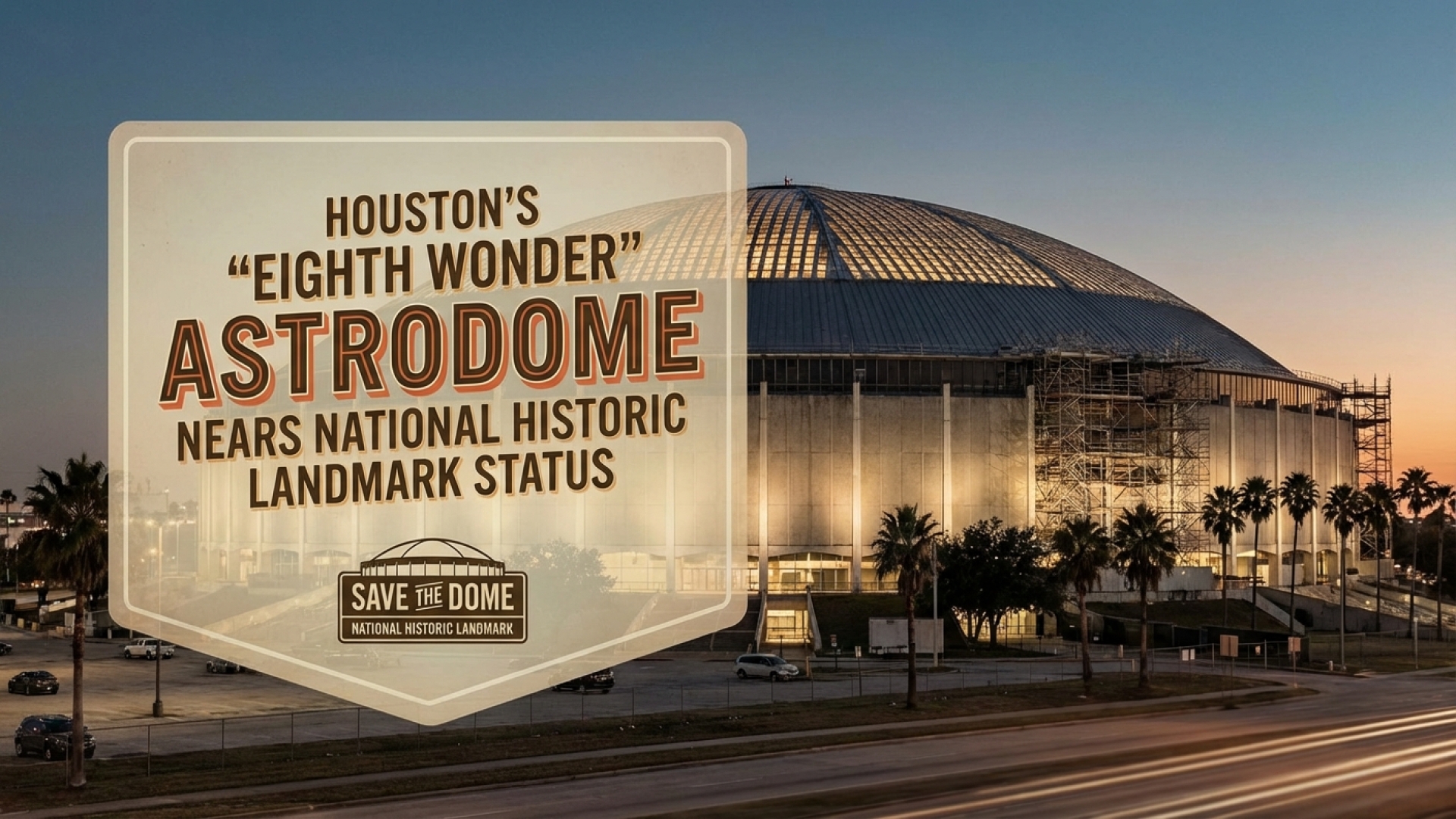
While sports fans in Western New York keep a close eye on the rising steel of the new Bills stadium in Orchard Park, a significant chapter of American architectural history is reaching a turning point in Texas. The iconic Houston Astrodome, a structure that once redefined the intersection of sports and engineering, has cleared a major hurdle in its quest for National Historic Landmark status.
The National Park Service recently confirmed that the “Eighth Wonder of the World” officially qualifies for consideration as a landmark of national significance. If approved by the Secretary of the Interior, the Astrodome would join an elite group of fewer than 3,000 sites—such as the Empire State Building or the Buffalo State Asylum for the Insane—recognized for their monumental impact on the American narrative. For a region like Buffalo, which has seen its own share of debates regarding the preservation of historic venues like the old War Memorial Stadium, the Astrodome’s journey offers a compelling look at the challenges of maintaining sporting heritage.
Engineering an Architectural Revolution
Opening its doors in 1965, the Astrodome was more than just a ballpark; it was a vision of the future. As the world’s first fully air-conditioned, domed multi-purpose stadium, it solved the sweltering heat issues of the Gulf Coast while introducing the world to “Astroturf.” This pioneering design shifted the global paradigm for venue construction, proving that massive indoor environments were both possible and profitable.
The following table illustrates the Astrodome’s place among early pioneering domed structures in North American sports history:
| Venue Name | Location | Year Opened | Primary Innovation |
|---|---|---|---|
| Houston Astrodome | Houston, TX | 1965 | First fully air-conditioned multi-purpose dome |
| Kingdome | Seattle, WA | 1976 | Concrete roof structure for multi-sport use |
| Pontiac Silverdome | Pontiac, MI | 1975 | Fiberglass fabric, air-supported roof |
| Carrier Dome | Syracuse, NY | 1980 | Largest air-supported dome in the Northeast |
A Venue of Historical “Firsts”
The stadium’s history is a highlight reel of 20th-century culture. It was the inaugural home for the MLB’s Houston Astros and later hosted the Houston Oilers (now the Tennessee Titans) starting in 1968. Beyond the major leagues, it was the site of the 1973 “Battle of the Sexes” tennis match, where Billie Jean King defeated Bobby Riggs in a moment that fundamentally changed the perception of women in sports.
However, the Astrodome’s legacy isn’t confined to box scores. In 2005, the venue pivoted from entertainment to humanitarian aid. Following the devastation of Hurricane Katrina, the stadium opened its doors as a massive shelter, housing tens of thousands of evacuees. This act of civic service transformed the structure from a local landmark into a symbol of national resilience.
The Long Road to Preservation
Despite its pedigree, the Astrodome has faced an uncertain future for over two decades. It has not hosted a major scheduled event since 2002 and lost its official certificate of occupancy in 2009. While local politicians and developers have proposed everything from luxury hotels to indoor parks, the building has largely been utilized for storage in recent years.
For Western New Yorkers who value the preservation of local history and community landmarks, the Astrodome serves as a cautionary and hopeful tale. The move toward National Historic Landmark status provides a layer of protection and prestige that could finally secure the funding and political will needed for a permanent adaptive reuse project.
Reporting for the Lake Erie Times, I will continue to follow how national preservation efforts influence the way we view our own regional infrastructure and sports venues. As Buffalo enters a new era of stadium construction, the fate of the Astrodome reminds us that today’s “wonders” require long-term vision to remain tomorrow’s landmarks.
About the Author: William Strasmore is a veteran reporter for the Lake Erie Times. Known for his investigative depth and impartial analysis, Strasmore covers the intersection of regional politics, business, and community development in Western New York.
Disclaimer: The content provided by Lake Erie Times is for informational purposes only and should not be considered as professional legal or financial advice. Some links on Lake Erie Times are affiliate links. This means that if you make a purchase through these links, we may earn a commission at no additional cost to you. Our recommendations are based on careful research and our commitment to quality journalism.