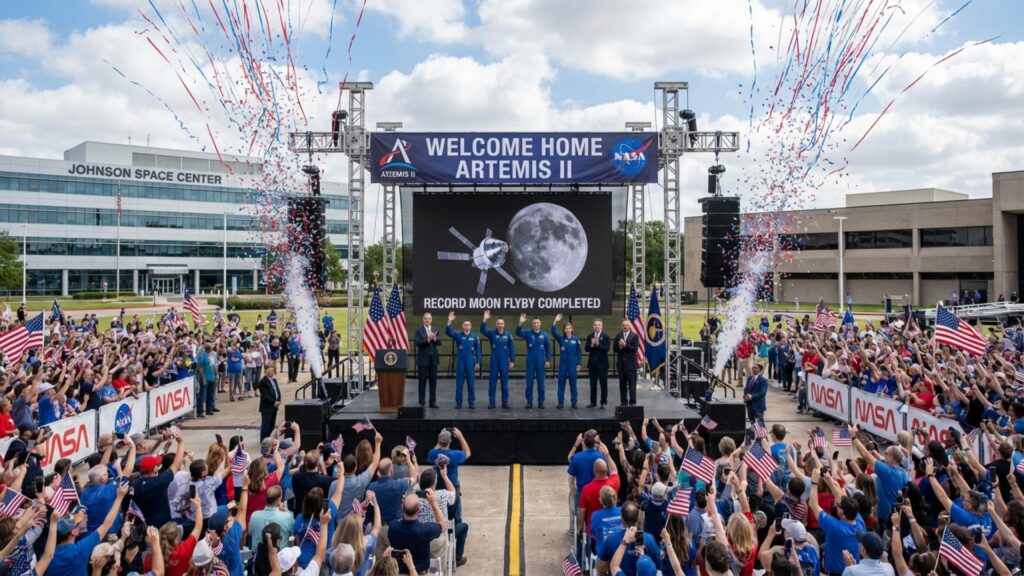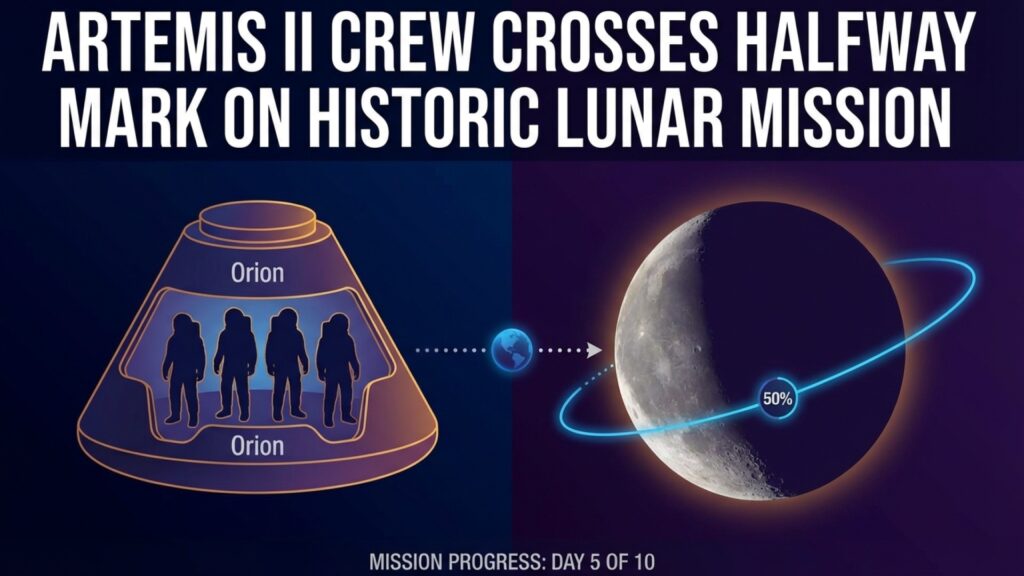
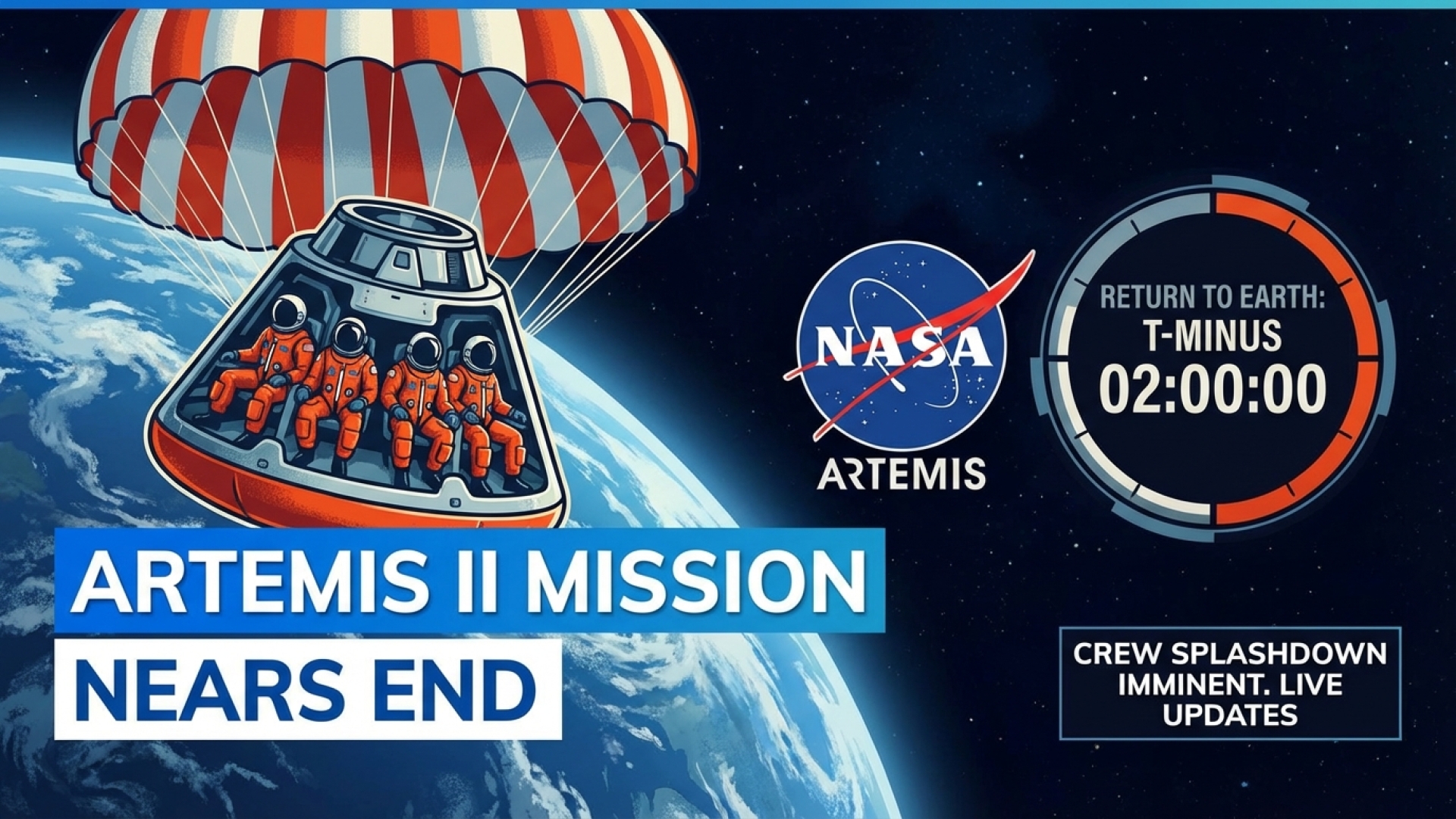
The eyes of the world, and certainly those across Western New York, are fixed on the heavens as the Artemis II mission approaches its historic conclusion. After breaking records and capturing unprecedented imagery of our lunar neighbor, the four-person crew is preparing for a high-stakes return to Earth scheduled for Friday, April 10.
For residents from Buffalo to the Niagara Frontier following this journey, the homecoming represents the final hurdle in a mission that has pushed the boundaries of modern space exploration. NASA’s ground teams are currently finalizing re-entry procedures, ensuring that every safety protocol is met before the Orion capsule hits the atmosphere.
On Thursday, NASA astronauts Reid Wiseman, Victor Glover, and Christina Koch, alongside Canadian Space Agency astronaut Jeremy Hansen, performed a comprehensive review of re-entry maneuvers. The crew is scheduled to execute a critical trajectory correction burn on Thursday evening, with thrusters engaging at 9:53 p.m. ET to fine-tune their approach path.
While the mission has been a resounding success thus far, NASA officials remain transparent about the inherent dangers of the return leg. Lakiesha Hawkins of NASA emphasized the gravity of the final hours, noting that landing the crew safely remains the most significant risk of the 10-day flight.

Splashdown Schedule and Location
NASA anticipates that the Orion capsule will splash down off the coast of San Diego at approximately 8:07 p.m. ET on Friday, April 10. This timing allows for optimal recovery conditions as the U.S. Navy stands by to retrieve the crew.
The Physics of Re-entry: 23,840 MPH
The return journey is a violent encounter with Earth’s atmosphere. This marks the first time NASA and the Department of Defense have collaborated on a lunar recovery since the Apollo 17 mission in 1972. Orion will hit the atmosphere at a staggering velocity of 34,965 feet per second—roughly 23,840 mph.
A primary concern for analysts and engineers has been the heat shield. During an uncrewed test in 2022, the shield sustained more wear than anticipated. To mitigate this for the Artemis II crew, NASA has modified the descent trajectory to manage the 5,000-degree Fahrenheit temperatures generated during re-entry. Future missions, including Artemis III, will feature a redesigned shield based on data gathered during this flight.
Artemis II Re-entry and Splashdown Timeline
The final hour of the mission is choreographed with precision. Below is the expected sequence of events leading to the Pacific Ocean splashdown:
| Time Relative to Splashdown | Event Description |
|---|---|
| -42 Minutes | Crew module separates from the service module; final trajectory adjustments made. |
| -13 Minutes | Orion enters Earth’s atmosphere at approximately 400,000 feet. |
| -10 Minutes | Six-minute communications blackout begins due to peak atmospheric heating. |
| -7 Minutes | Crew experiences maximum G-forces (up to 3.9 times their body weight). |
| -4 Minutes | Drogue parachutes deploy at 22,000 feet to stabilize the capsule. |
| -2 Minutes | Three main parachutes deploy at 6,000 feet to slow descent. |
| 0 Minutes | Splashdown in the Pacific Ocean. |
Following the splashdown, the U.S. military will utilize helicopters to extract the spacecraft and transport it to the USS John P. Murtha. The astronauts will receive immediate medical evaluations on the ship before being transported back to the Johnson Space Center in Houston.
How to Watch the Return
For those in Western New York wishing to witness this historic event live, NASA will begin its broadcast coverage at 6:30 p.m. ET on Friday. In addition to NASA’s official YouTube channel and website, the stream will be available on several major platforms including Amazon Prime Video, Apple TV, Netflix, and Roku.
The Road to a Sustainable Lunar Base
The success of Artemis II sets the stage for even more ambitious endeavors. Artemis III is slated to test docking procedures between the Orion capsule and lunar landers in Earth’s orbit. By 2028, Artemis IV aims to land astronauts near the moon’s south pole, a pivotal step toward Lake Erie Times’ continued coverage of NASA’s goal to establish a permanent human presence on the lunar surface.
The Associated Press contributed to this report.
About Lake Erie Times: Lake Erie Times is your comprehensive source for the latest news, insights, and stories from Buffalo, New York, and the broader Western New York region. Our mission is to provide accurate, in-depth coverage that fosters informed dialogue within our community.
Disclaimer: The content provided by Lake Erie Times is for informational purposes only and should not be considered as professional legal or financial advice.
Affiliate Disclaimer: Some links on Lake Erie Times are affiliate links. If you make a purchase through these links, we may earn a commission at no additional cost to you. Our recommendations are based on careful research and our commitment to quality journalism.