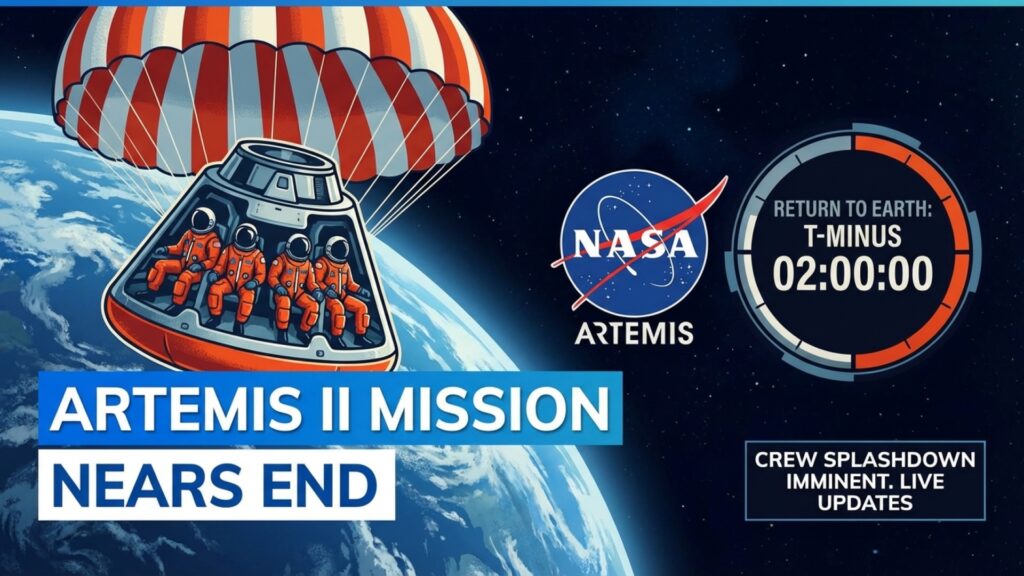

As the global community turns its eyes toward the heavens, the Artemis II mission stands as a monumental leap in human exploration, representing the first crewed journey to the lunar vicinity in more than half a century. This ambitious 10-day endeavor is designed to push the boundaries of current aerospace technology, specifically focusing on the performance of the Orion capsule. For residents across Western New York and the broader Lake Erie region, this mission signals a return to the pioneering spirit that once defined the Apollo era, serving as a critical precursor for eventual human footprints on Mars.
Planned Launch Windows for the Lunar Voyage
Precision is the cornerstone of spaceflight, and NASA has identified several specific windows for the upcoming launch. These timings are calculated to ensure optimal trajectory and safety for the crew. At Lake Erie Times, we are tracking these developments closely to keep our community informed of when to watch the skies. The anticipated launch windows in Eastern Time are detailed below:
| Date | Launch Window (ET) |
|---|---|
| April 1 | 6:24 p.m. – 8:24 p.m. |
| April 2 | 7:22 p.m. – 9:22 p.m. |
| April 3 | 8:00 p.m. – 10:00 p.m. |
| April 4 | 8:53 p.m. – 10:53 p.m. |
| April 5 | 9:40 p.m. – 11:40 p.m. |
| April 6 | 10:36 p.m. – 12:36 a.m. |
| April 30 | 6:06 p.m. – 8:06 p.m. |
The Crew: Veterans and Pioneers
The success of this historic flight rests in the hands of four highly skilled professionals. This diverse team consists of three seasoned NASA astronauts and one representative from the Canadian Space Agency. Their primary objective during the 10-day trek is to rigorously evaluate life support systems and operational protocols in the harsh environment of deep space.
The flight deck includes Commander Reid Wiseman, a veteran of long-duration missions, and Pilot Victor Glover, whose extensive flight experience is vital for the mission’s technical maneuvers. Joining them are Christina Koch, who holds records for female spaceflight endurance, and Jeremy Hansen of Canada, a former fighter pilot embarking on his first mission beyond Earth’s orbit.
Navigating the Path to the Moon
The flight path for this mission is a masterclass in celestial mechanics. Initially, the Orion spacecraft will enter a high Earth orbit for approximately 25 hours. During this period, the crew will perform critical proximity operations, using the upper stage of the Space Launch System (SLS) rocket as a reference point to practice manual handling and docking maneuvers, maintaining a safe distance of no less than 33 feet.
Once Earth-bound tests are complete, the main engine will ignite, sending the crew 244,000 miles toward the lunar surface. The mission utilizes a free-return trajectory—the same “failsafe” physics that allowed Apollo 13 to return safely. By leveraging the gravitational influence of both the Earth and the Moon, the spacecraft requires significantly less fuel for the return leg. On the sixth day, Orion will reach a milestone, traveling 5,000 miles past the far side of the Moon. This will establish the crew as the most distant human travelers in history, eclipsing the previous record set decades ago.
Scientific Insights from the Lunar Far Side
The six-hour flyby of the lunar far side offers a rare scientific opportunity. Because this region is never visible from Earth, the crew’s observations are invaluable. Equipped with high-resolution cameras and advanced mobile smartphone technology, the astronauts will document the cratered terrain, which differs significantly from the “near side” familiar to us in Western New York.
These observations will support NASA’s long-term goal of establishing a sustainable human presence on the Moon. For more updates on science and lifestyle trends affecting our region, stay tuned to our local news coverage. Following their observations, the crew will begin the trek home, concluding with a scheduled splashdown on flight day 10, approximately nine days and two hours after departure.
Editor’s Note: This report includes information sourced from the Associated Press. Lake Erie Times is committed to providing accurate and in-depth news for the Western New York community. The content provided is for informational purposes and does not constitute professional advice. Some links may be affiliate links; see our disclosure for more details.