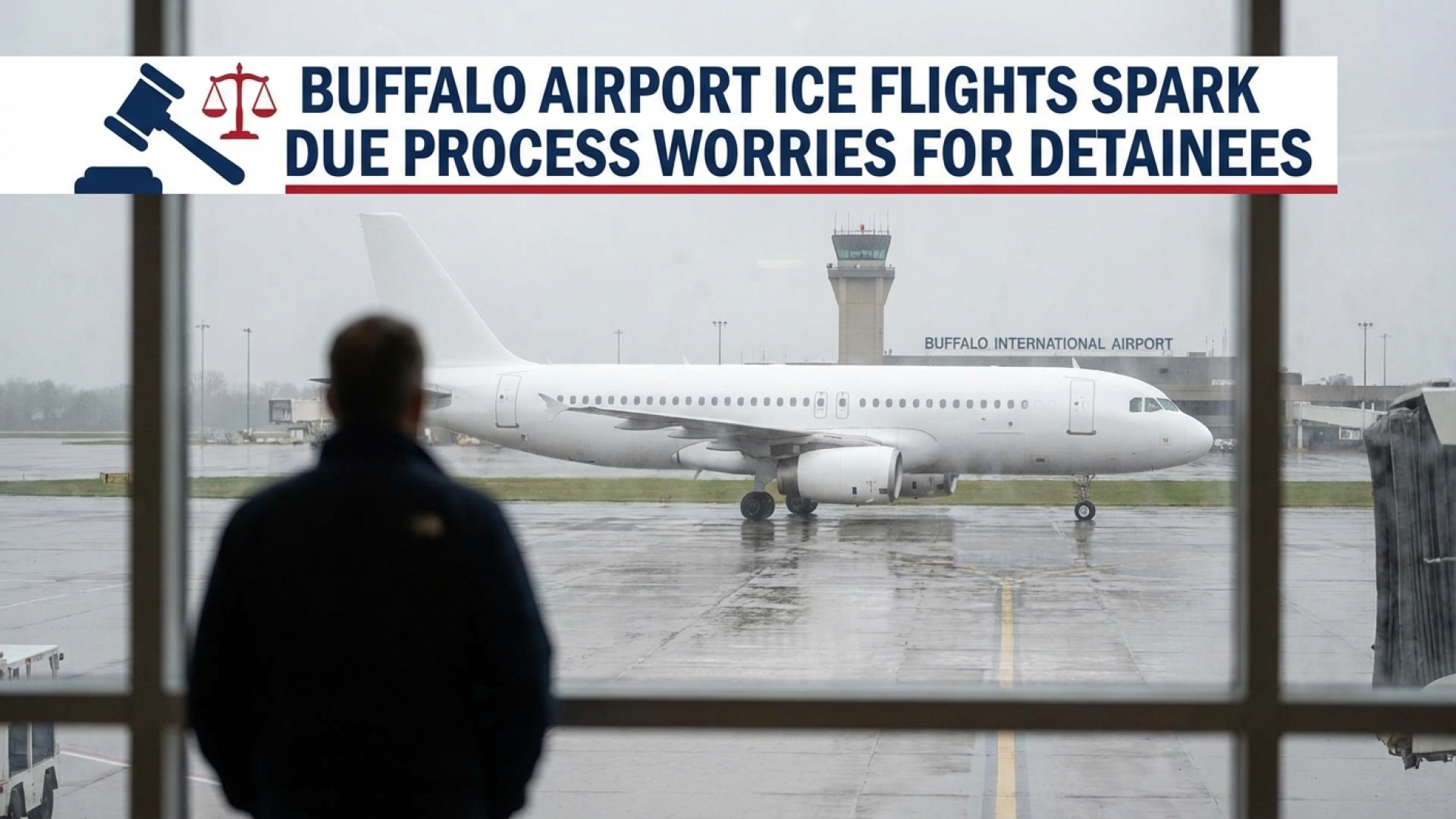
Routine flights chartered by U.S. Immigration and Customs Enforcement (ICE) out of Buffalo Niagara International Airport are transporting detainees from the Batavia facility, often without the knowledge of legal counsel. This practice, occurring right in our Western New York backyard, raises significant questions regarding transparency and the protection of constitutional rights.
Unmarked Flights Raise Constitutional Concerns at Buffalo Airport
A Boeing 737, frequently unmarked and registered to Tvpx Ars Inc Trustee as an Eastern Air Express flight (N668CP), has become a regular fixture at the private terminal of the Buffalo Niagara International Airport (BNIA). Unlike standard commercial travel, these operations are specifically chartered by ICE to move individuals from the federal detention center in Batavia. Since the start of 2025, more than 226 of these flights have cycled through the region, sparking an investigative look into the due process afforded to those on board.
Analyzing Flight Patterns and Destinations
Comprehensive data analysis reveals a consistent schedule, with ICE-chartered aircraft operating multiple times per week—most notably on Thursday and Saturday mornings. In September 2025 alone, 59 such flights were recorded. These operations facilitate a nationwide network of detainee movement, often shifting individuals to facilities with much larger capacities or closer proximity to the southern border.
Outgoing Flights from Buffalo
| Destination City | Airport Code | Flight Count |
|---|---|---|
| Alexandria, LA | KAEX | 53 |
| Willow Run/Detroit, MI | KYIP | 12 |
| Harrisburg, PA | KMDT | 10 |
| El Paso, TX | KELP | 7 |
| Harlingen, TX | KHRL | 7 |
While the primary hubs include Louisiana and Texas, other outgoing destinations from Buffalo have included Baltimore, MD; Richmond, VA; Mesa, AZ; San Antonio, TX; Minneapolis, MN; and Calgary, Canada. Harrisburg frequently serves as a tactical stop to board additional detainees before heading south.
Incoming Flights to Buffalo
| Origin City | Flight Count |
|---|---|
| Bedford/Boston, MA | 41 |
| Alexandria, LA | 26 |
| Youngstown, OH | 26 |
| El Paso, TX | 5 |
| San Antonio, TX | 4 |
Additional arrivals originated from Newark, NJ; Portsmouth, NH; and Milwaukee, WI, reinforcing Buffalo’s role as a northern transit hub for federal immigration enforcement.
Legal Hurdles and Due Process Obstacles
The frequency of these transfers presents a logistical nightmare for legal professionals in Western New York. Matthew Borowski, an immigration attorney with Borowski Whitmer, reports a surge in demand, with his firm managing over 300 clients in a six-month window. A primary tool for these attorneys is the habeas corpus petition, which requests that a court review the legality of a person’s detention.
However, the rapid nature of these transfers often thwarts legal action. Borowski noted instances where staff arrived in Batavia to obtain necessary signatures only to find the client had been flown out of state hours earlier. This loss of physical presence in the district effectively strips New York courts of jurisdiction, forcing families to scramble for new legal representation in distant states under grueling deadlines.
Batavia Detention Center: Overcrowding and Demographics
Data released in February 2026 indicates the Batavia facility is operating well beyond its intended limits. While the center has a rated capacity of 650, it recently held 745 detainees. Despite this congestion, the demographic profile of those held suggests a low security risk.
| Category | Percentage |
|---|---|
| No Criminal History | 83% |
| Determined “No Threat” by ICE | 80% |
| Average Stay (as of Feb 2026) | 37 Days |
This overcrowding likely fuels the rapid transfer of individuals to southern facilities. However, these movements carry heavy legal consequences, as courts in jurisdictions like Texas and Louisiana historically issue rulings more favorable to federal enforcement than those in the Northeast.
Constitutional Implications of Civil Enforcement
Stephen Yale-Loehr, a distinguished immigration law expert at Cornell University, emphasizes that immigration enforcement remains a civil matter. Under the Constitution’s Due Process Clause, all individuals within the U.S. borders are entitled to a hearing before deportation. By moving detainees across state lines before a habeas corpus petition can be filed, the government may be inadvertently—or strategically—undermining this fundamental right.
For many in the local political sphere, these flights represent a opaque system that operates out of public view but with deep local impact. The ability to challenge one’s detention is a cornerstone of the American legal system, yet for those processed through Buffalo, that right often depends on whether they are still on the ground when the paperwork is filed.
The Community Impact in Western New York
The human cost of this high-speed transfer system is felt most acutely by families in the Buffalo region. “Families are being fractured,” Borowski states, noting that many detainees are long-term residents who serve as the primary breadwinners for their households. When a parent is moved from Batavia to a facility in rural Louisiana without notice, the emotional and financial strain on the remaining family members is devastating.
As Lake Erie Times continues to monitor these developments, ICE has remained silent regarding the specific criteria for these transfers. For the residents of Western New York, the unmarked planes at BNIA serve as a stark reminder of the complex and often hidden intersection of federal policy and local community life.
Disclaimer: The content provided by Lake Erie Times is for informational purposes only and should not be considered as professional legal or financial advice. Some links on Lake Erie Times are affiliate links; we may earn a commission at no additional cost to you based on our commitment to quality journalism.