
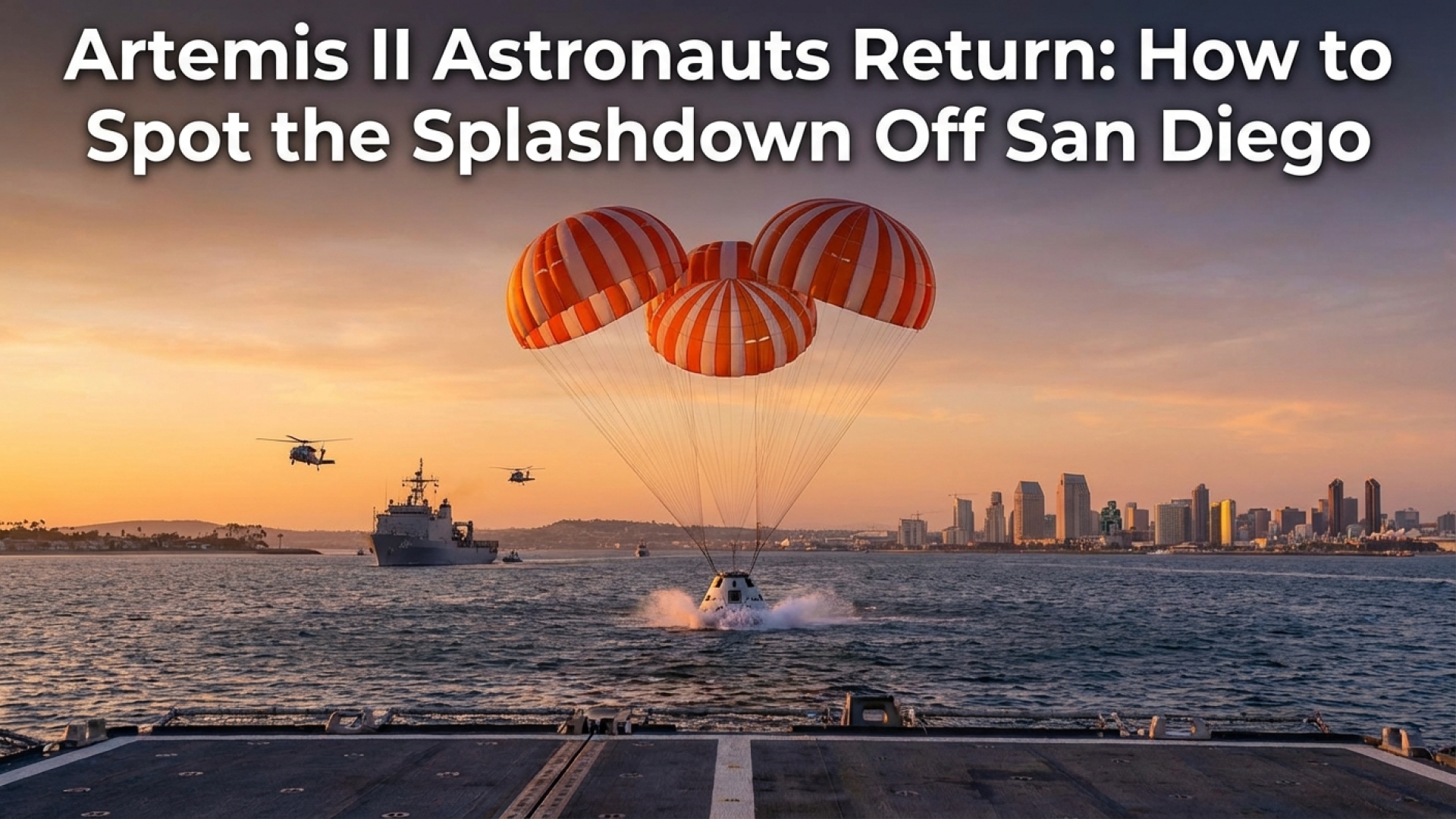
The Artemis II crew is beginning the final leg of their journey back to Earth, marking the conclusion of a landmark moon-orbiting mission. Following their successful navigation around the lunar surface, the Artemis II astronauts are scheduled for recovery by the U.S. Navy after their command module splashes down this Friday off the coast of San Diego.
On Monday, the U.S. Navy confirmed that the USS John P. Murtha, an amphibious transport dock ship based in Southern California, has been designated as the primary recovery vessel. For weeks, sailors assigned to the Murtha have undergone rigorous training to master the specialized procedures required to retrieve the four astronauts and their spacecraft. The space capsule is currently projected to breach the atmosphere and return to the Pacific waters just after 5 p.m. PST on Friday.
“About 50 miles offshore, there will be rescue boats stationed. This is part of the reason San Diego is so critical to the mission,” noted Francisco Contreras, a board member for the San Diego Astronomy Association. “As a premier Navy hub, the region has the specialized facilities and infrastructure necessary to support these astronauts during their transition back to Earth.”
The recovery operation involves a coordinated effort across multiple branches. A U.S. helicopter squadron, operating out of Naval Air Station North Island, will be tasked with tracking the capsule as it descends through the atmosphere. Once the vessel is stabilized in the water, the team will extract the four crew members and transport them directly to the USS John P. Murtha for immediate medical assessments and debriefing.
Planned Splashdown and Visibility
Current trajectory projections place the Artemis II splashdown in the Pacific Ocean, specifically in the corridor between San Clemente Island and Catalina Island. While the recovery is a maritime operation, there is significant interest from coastal observers hoping to catch a glimpse of the capsule’s re-entry.
“I would recommend heading to the coast,” Contreras suggested for those in the area. “Because the capsule is coming in from such a high altitude, it should be visible from the shoreline. As long as you have a clear, unobstructed view to the northwest, you have a strong chance of witnessing this historic return.”
For Western New York residents following the mission from home, the return of Artemis II represents a major milestone in the United States’ objective to establish a sustainable presence on the moon. The success of this recovery operation will pave the way for future lunar landings and continued exploration of the deep space frontier.
About William Strasmore: William Strasmore is a dedicated news reporter for Lake Erie Times in Western New York. With an extensive background in investigative journalism, William provides in-depth, impartial coverage and incisive analyses on community affairs, local politics, and major national events affecting our region.
About Lake Erie Times: Lake Erie Times is your comprehensive source for the latest news, insights, and stories from Buffalo, New York, and the broader Western New York region. Our mission is to provide accurate, in-depth coverage that fosters informed dialogue within our community.
Disclaimer: The content provided by Lake Erie Times is for informational purposes only and should not be considered as professional legal or financial advice.
Affiliate Disclaimer: Some links on Lake Erie Times are affiliate links. This means that if you make a purchase through these links, we may earn a commission at no additional cost to you. Our recommendations are based on careful research and our commitment to quality journalism.